There is no good time to clear out a parent's house, and no version of it that feels tidy. You are sorting through a lifetime while still absorbing the fact that it has ended, and the two jobs do not cooperate. Most families walk in expecting a long weekend of hard work. What they find is that every third item asks a question nobody is ready to answer, and the weekend turns into a month.
This guide is written for that month. It is not about emptying the house quickly — that is the wrong goal and it produces regret. It is about working in an order that protects what is worth protecting, keeps the family talking, and gets the volume out in stages you can survive. For the plain mechanical version, our room-by-room cleanout checklist covers it. This one assumes the house belonged to someone you loved.
Plan for Two to Three Times Longer Than You Think
What consumes the time is decision fatigue layered on grief. Emptying a linen closet takes twenty minutes. Emptying one where your mother's handwriting is on the shelf label takes an hour, and it takes something out of you that the next room will need. People sit down. People leave and come back. That is the actual shape of the work, and a plan that does not allow for it will fail on day two.
So build slack into the schedule. If the physical job looks like three days, block out a week or more and expect to use most of it. Work half-days rather than marathons; four focused hours is a good session, and eight produces decisions people regret. Kingsport makes this harder than most. Much of the older housing stock here has a full basement, a floored attic and a detached garage, and in families settled in Sullivan or Hawkins County for generations, all three have been quietly filling since the 1960s — often three houses' worth of belongings, not one.
Do the Documents Pass Before Anything Moves
This is the most important sequencing rule in estate work: nothing leaves the house, gets donated, or goes in a container until someone has done a deliberate paper sweep. Once a box is on a truck it is gone, and what disappears this way is exactly what you will need later.
Send one or two people through with a box and a marker, looking only for paper and small valuables. Not sorting, not cleaning — collecting. What you are after:
- Deeds, mortgage papers, and anything relating to land or a burial plot
- Vehicle titles, including for a trailer, boat, camper or tractor
- Insurance policies — life, home, auto, and old paid-up policies people forget
- Tax records and bank and investment statements, several years back
- Military discharge papers and service records, which matter for benefits
- Birth, marriage and death certificates; Social Security cards; passports
- Safe deposit box keys and any note about where the box is
- Photographs, letters and albums — set these aside and decide about them last
All of it goes to the executor or the estate's attorney. Do not sort it yourself and do not discard what looks like junk mail; a single statement can be the thread that finds an account nobody knew about.
The Places People Hide Things
An older generation, raised by people who lived through the Depression, did not always trust banks with everything. Before a piece of furniture leaves, check it properly:
- Taped under drawers — pull every drawer all the way out and look at the underside, and at the back panel behind it
- Inside book jackets, and between the pages of Bibles, cookbooks and photo albums
- Coat and trouser pockets, and inside shoes and handbags in the back of closets
- The freezer, in foil packets and old margarine tubs
- Behind mirrors and framed pictures, and under drawer liners
- Coffee cans and tool chests in the garage, and jars on basement shelving
It sounds excessive until it isn't. Cash, jewelry, savings bonds and handwritten notes about intentions turn up in all of these places, and a container does not give anything back.
Get an Opinion on Value Before Anything Is Discarded
Families throw away money in estate cleanouts, usually in good faith and in the last hour of a long day. The categories that most often carry unexpected value: old tools, costume jewelry, mid-century furniture, firearms, coins and currency, military items, pottery and glassware, sewing machines, and anything tied to a local business or the railroad. If you are unsure, photograph it and set it aside rather than deciding while tired, and get a qualified opinion before anything is donated or discarded. An appraisal costs a fraction of what a misjudged decision does, and it settles arguments — a number from an outside party is easier for siblings to accept than an estimate from one of them.
When Two People Want the Same Thing
Most family conflict in an estate is not about money. It is about a chair, a ring, or a set of dishes that two people remember differently. Some ground rules that help:
Check the will and the executor first. Specific bequests are not up for negotiation, and the executor has authority the rest of the family does not. Estate administration varies from state to state and depends on the documents involved — this article is not legal advice, and questions about what may be distributed, and when, belong with the estate's attorney or the executor rather than the group standing in the kitchen.
Take rounds, not free-for-alls. Draw for order, then each person selects one item per round, reversing the order each round. It is slow and it is fair, and fairness prevents the thing that happens otherwise, where someone quietly stops coming to Christmas.
Let a disputed item wait. Nothing is improved by settling it that day. Put it in the undecided pile and revisit it when nobody is running on four hours of sleep.
The Four-Pile Method, Adapted for Grief
The standard method — keep, donate, sell, discard — assumes a clear head. In an estate cleanout it needs a fourth pile that is not a failure: undecided.
Undecided is a legitimate destination. It is where the thing you cannot look at yet goes, and naming it lets you keep moving instead of stalling in a doorway. Two conditions keep it from becoming a way to avoid the job. It needs a physical boundary — one room, or a marked corner of the garage — and when it is full it is full. And it needs a date: put a real one on the calendar four to eight weeks out, and agree in advance how anything still undecided gets handled. Keeping a box for a year is fine if it is a choice. It is only a problem when nobody ever decided.
Things That Need Their Own Route
Medications
Estate houses often hold years of accumulated prescriptions, including controlled substances. These do not belong in the trash or the container, and flushing is not the default answer either. The DEA runs national take-back events and maintains permanent collection sites, many at pharmacies and law enforcement offices; the current list and guidance are at deadiversion.usdoj.gov. Handle this early, with more than one family member present.
Firearms
Firearms are common in houses around here and need care on two fronts. Practically: assume any firearm is loaded, do not attempt to unload one you are not trained on, and secure everything found before the house sees traffic. Legally: rules for transferring, inheriting, selling and transporting firearms vary by state and by circumstance, and this article cannot tell you what applies to your situation. Speak with a licensed firearms dealer, the estate's attorney, or local law enforcement before anything is moved or handed to anyone.
Paint, Chemicals and the Rest
Basements and detached garages here hold decades of paint, solvents, thinners, pesticides, fuel and automotive fluids, plus propane cylinders and old batteries. None of it can go in a roll-off. Tennessee's environment department runs household hazardous waste collection service for counties across the state — see tn.gov/environment — and the EPA's overview at epa.gov/hw explains the categories. Our recycling and disposal guide covers where these streams go, and what can and cannot go in a dumpster has the exclusion list. Set a bench aside for this material on day one.
A Staged Plan You Can Actually Follow
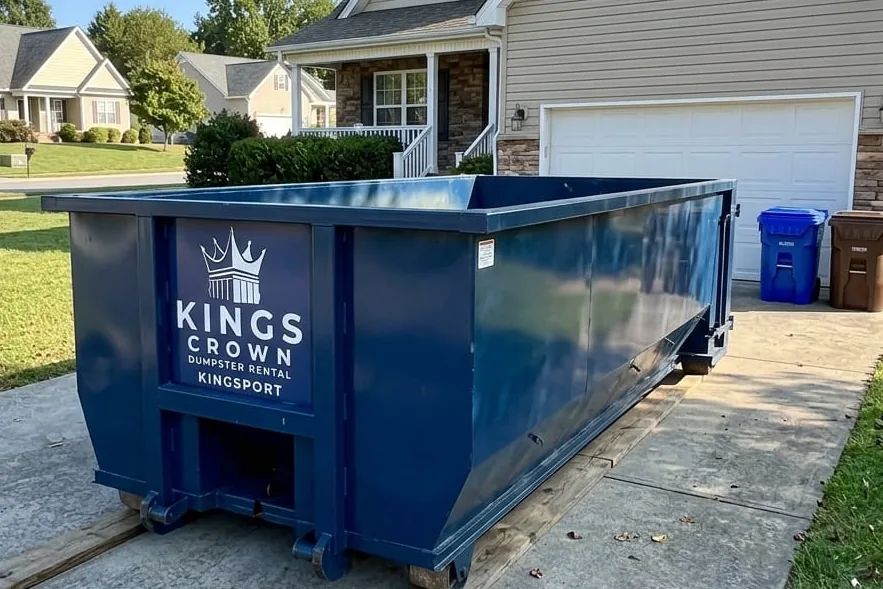
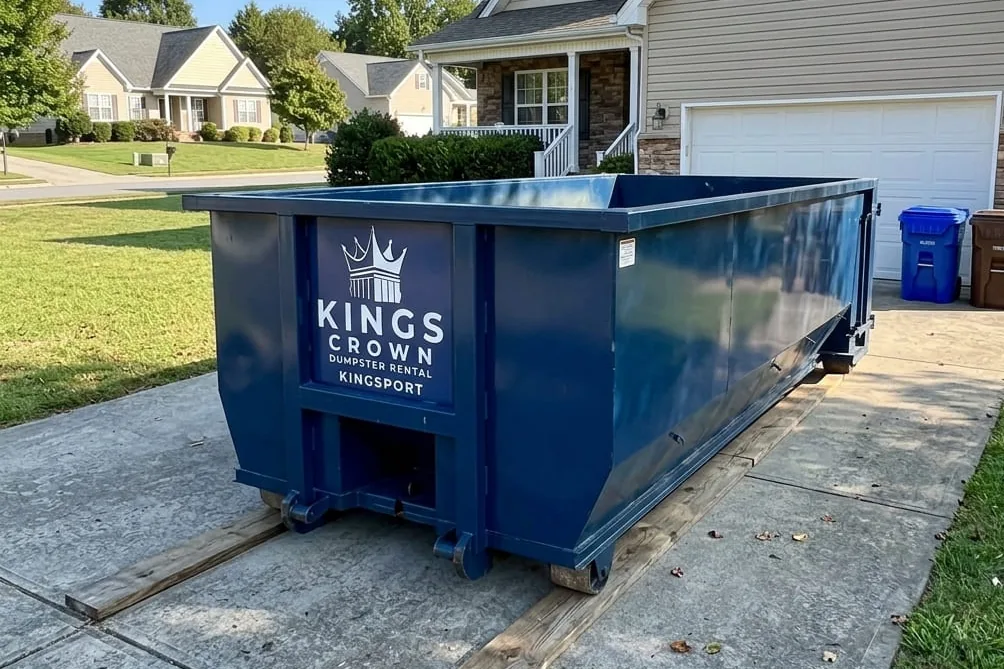
Estate volume is deceptive. Loose household goods compress badly and fill faster than construction debris, and the outbuildings usually hold more than the house. For a modest home with a basement or garage in scope, a 20 yard is a reasonable start; for a full property with decades of storage, a 30 yard saves a second haul. Our containers carry roughly 1-2 tons on a 10 yard, 2-3 on a 15, 3-4 on a 20, 4-5 on a 30 and 5-6 on a 40; the size guide has the dimensions, and our sizing guide works through the estimate. If the lower level has ever taken water, size up — damp carpet and saturated cardboard weigh far more than they look.
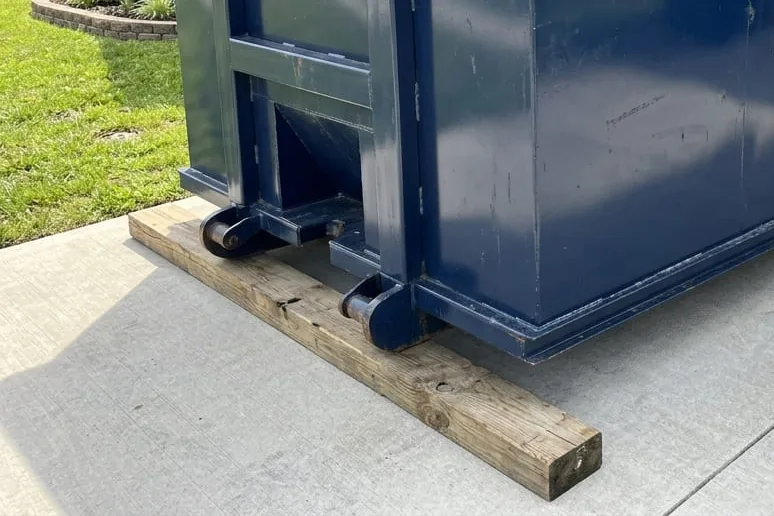
Two smaller containers over several weeks usually beats one large one sitting for a month, because it matches how the work actually goes. Put it where the family can walk past without confronting it every time, and away from the door the keepsakes are leaving through. Sloped and gravel driveways are common here, so discuss placement before delivery rather than on the day. See estate cleanouts, or get in touch and we will talk through timing.
You will not do this perfectly. Something will be thrown away that someone wishes had been kept, and someone will keep something they later cannot explain. That is not a failure of planning; it is what this work is. The measure of a good estate cleanout is not an empty house — it is that the important papers were found, nothing valuable went out by mistake, and the family is still speaking at the end of it. Go slowly. It gets done.