
For jobsites
Construction Dumpster Rental Kingsport TN
A jobsite that runs out of container capacity stops being a jobsite. We supply 20, 30 and 40 yard roll-offs to builders and remodelers across Sullivan and Hawkins counties, with swap timing set around framing, drywall and trim rather than a fixed calendar.
- Licensed & insured
- Same-day delivery
- Flat-rate pricing
- Locally owned
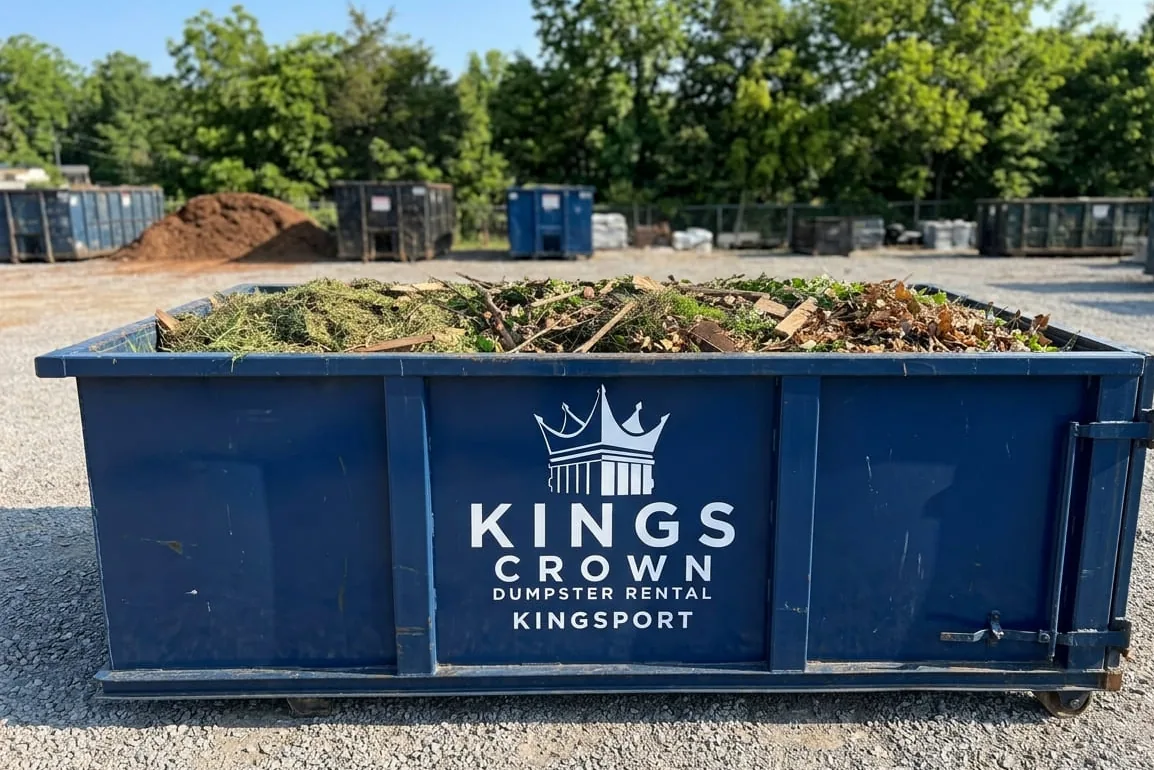
Construction Dumpster Rental Kingsport TN across Kingsport and Sullivan County
Construction debris arrives in waves. Demolition and site prep come first, then framing scrap, then a quiet stretch through rough-in, then a hard surge when drywall and finish material hit at once. A container schedule that ignores those waves either strands a crew with a full box or leaves an empty one parked in the way for a fortnight. Kings Crown Dumpster Rental plans jobsite disposal around the phases, not around a default weekly pickup.
We work with general contractors, remodelers, framers and owner-builders throughout Kingsport, Colonial Heights, Church Hill, Mount Carmel and the surrounding Sullivan and Hawkins county communities. Containers run from 10 up to 40 yards, and most active builds sit on a 30 or a pair of 20s.
Matching Container Size to the Build Phase
The single most useful thing to know about jobsite debris is that density changes completely from one phase to the next. Framing scrap is light and springy and fills volume long before it approaches a weight limit. Drywall offcuts are dense and stack flat. Tile, mortar, brick and old plaster will hit the tonnage ceiling with the container barely half full.
| Phase | Typical material | Container that suits it |
|---|---|---|
| Site prep and interior strip-out | Old finishes, plaster, tile, cabinetry | 20 yard, weight-limited before it looks full |
| Framing and sheathing | Lumber offcuts, engineered scrap, banding | 30 or 40 yard, volume-limited, very light per cubic yard |
| Roofing and siding | Shingles, felt, wrap, vinyl or fiber cement | 20 yard for tear-off, 30 yard for siding |
| Drywall, trim and finish | Board offcuts, packaging, flooring waste | 30 yard, steady fill through several weeks |
| Final clean and punch list | Mixed light debris, packaging, protection | 15 or 20 yard for a short final swap |
Our construction debris dumpster guide works through this in more detail, and full dimensions for every container are on the sizes page. The 40 yard dumpster is the right call for framing volume, but only where the material is genuinely light and the site has room for the truck.
Jobsite Access and Placement
Access is the constraint that catches out builders working new lots in this terrain. Ridge-and-valley ground means cut-and-fill pads, steep temporary drives and turning space that exists on the plan but not yet on the ground. A roll-off truck needs a firm, reasonably level surface, roughly sixty feet of straight approach, and clearance overhead for the hoist to run.
On an unfinished site that usually means putting stone down early and keeping it maintained. Red clay subgrade holds water, and a temporary drive that carries a concrete truck in dry weather will not carry a loaded roll-off after three days of rain. Practical measures that keep deliveries on schedule:
- Establish the container pad on stone before the first delivery, not after the first stuck truck
- Keep the approach clear of material stacks, portable toilets and subcontractor parking
- Position the box where trades will actually walk to it, or it will fill with debris around it instead of in it
- Call 811 for utility locates before any digging, grading or driving stakes on site
- Flag temporary power drops and overhead lines that could foul the hoist
Tennessee 811 is the state one-call service, and locates need to be requested before excavation begins. That applies to the container pad and temporary drive as much as to footings.
Mixed C&D Versus Separated Loads
Most builds run a single mixed construction and demolition container, and for a typical residential job that is the sensible default. Separation earns its keep on larger projects where the volumes justify a second box. Clean wood, scrap metal, cardboard, and clean concrete or masonry each have their own outlets. Once those materials are mixed with drywall and general debris, the whole load is handled as mixed waste.
If your project has a waste diversion requirement, whether from an owner, a lender or a certification program, tell us at the quoting stage. Separation has to be designed into the site layout from the start, because a crew will not walk debris past a nearer container to reach the correct one. Concrete, brick and block are heavy enough to warrant their own handling in any case, which our concrete and heavy debris service covers.
Materials That Cannot Go in a Jobsite Container
Standard construction debris is straightforward: lumber, sheathing, drywall, insulation, roofing, siding, flooring, windows, doors, trim, packaging and general site waste. The exclusions are the same everywhere and they matter more on a commercial jobsite because the quantities are larger.
- Paints, solvents, adhesives, fuels and any liquid waste
- Propane and other pressurized cylinders
- Whole waste tires, lead-acid batteries and used oil, which Tennessee law bars municipal solid waste facilities from accepting
- Asbestos-containing material, which requires licensed abatement and separate disposal
- Sealed units still holding refrigerant
Renovation work in older Kingsport stock deserves specific attention. Buildings from before roughly 1980 may contain asbestos in floor tile, mastic, pipe insulation and siding, and the federal framework for identifying and handling it is described at epa.gov/asbestos. Work disturbing painted surfaces in pre-1978 housing falls under federal lead-safe renovation rules. Neither material goes in a roll-off, and a survey before demolition is cheaper than a stopped job.
Keeping Swaps Off the Critical Path
Disposal should never be the reason a crew stands down. The practical fix is a standing swap schedule that we adjust after the first two cycles, once we can see the real fill rate rather than the estimate. On a fast-moving build we would rather come a day early than a day late, because an empty container costs less than an idle framing crew.
We also plan around the site calendar. Inspections, concrete pours, crane days and material deliveries all conflict with a truck needing sixty feet of approach. Give us those dates when the schedule firms up and we will work around them. For a container needed at short notice mid-build, our same-day service covers the gap. Call (423) 830-4153 and we will size the job from a plan set or a few site photos.
Which size suits the job
Framing and finish phases suit a 30 or 40 yard container because the debris is bulky and light. Strip-out and masonry phases suit a 20 yard, since plaster, tile and mortar reach the tonnage limit with the box half full. Match the size to what the material weighs per cubic yard, not to the square footage of the building.
- Swap schedules keyed to framing, drywall and finish phases
- 20, 30 and 40 yard containers for mixed C&D debris
- Separate boxes for clean wood, metal or masonry on larger builds
- Placement planning for unfinished pads and temporary drives
- Guidance on asbestos surveys before renovation of older stock
Sizes
Which container for construction dumpster rental?
Every service runs in all four sizes. Match the material to the weight allowance and the rest takes care of itself.
| Size | Dimensions | Capacity | Weight included | Best for |
|---|---|---|---|---|
| 10 Yard Dumpster | 12 ft long × 8 ft wide × 3.5 ft high | about 3 pickup truck loads | 1–2 tons | Small bathroom remodels, single-room cleanouts, concrete and heavy debris, roofing up to about 15 squares. |
| 15 Yard Dumpster | 16 ft long × 8 ft wide × 4 ft high | about 4–5 pickup truck loads | 2–3 tons | Basement and attic cleanouts, kitchen remodels, medium roof tear-offs, small deck removals. |
| 20 Yard Dumpster | 22 ft long × 7.5 ft wide × 4.5 ft high | about 6 pickup truck loads | 3–4 tons | Whole-home decluttering, flooring and siding jobs, large tear-offs, drywall and mud phases. |
| 30 Yard Dumpster | 22 ft long × 8 ft wide × 6 ft high | about 9 pickup truck loads | 4–5 tons | Full-house renovations, new construction, estate clearances, commercial fit-outs and demolition. |
| 40 Yard Dumpster | 22 ft long × 8 ft wide × 8 ft high | about 12 pickup truck loads | 5–6 tons | Large commercial fit-outs, industrial clear-outs, major renovations and high-volume light debris. |
Talk to a real person
Need construction dumpster rental in Kingsport?
Call (423) 830-4153 and describe the job. You will get a flat price and a delivery time on the same call — most orders before noon go out the same day.
Mon–Sat 7:00am – 6:00pm · Sun by appointment
Answers
Construction Dumpster Rental — your questions
What size dumpster does a typical residential build need?
Most single-family builds run a 30 yard container through the main phases, swapped as it fills. Framing generates the greatest volume and the least weight, so a 40 yard can make sense there if the site has room for the truck. Strip-out and masonry phases are better served by a 20 yard, because heavy material reaches the weight limit long before it fills the walls.
Can you deliver to a site that has not been graded yet?
Often, but the approach has to be firm enough to carry a loaded truck. Ridge-and-valley sites here are cut-and-fill on red clay, and a temporary drive that handles a concrete truck in dry weather can rut badly after rain. Putting stone down for the container pad and approach before the first delivery is the single best investment on an unfinished site.
Do we need to separate recyclable construction material?
Not by default. Most residential builds run one mixed C&D container, and that is normally the most economical approach. Separation earns its keep on larger projects, or where an owner, lender or certification program sets a diversion target. It has to be designed into the site layout from day one, because crews will not carry debris past a closer container to reach the right one.
What happens if we find asbestos partway through a renovation?
Stop disturbing the material and get it tested. Buildings from before roughly 1980 may contain asbestos in floor tile, mastic, pipe wrap and siding, and it cannot go in a roll-off under any circumstances. Confirmed asbestos requires licensed abatement and separate disposal. A survey before demolition begins is far cheaper than an unplanned stop-work partway through the schedule.
How quickly can you swap a full container mid-build?
Usually within a day, and often the same day when a container is nearby and the site has clear access. On active builds we prefer a standing swap schedule that we tune after the first two cycles, once the real fill rate is visible. Tell us your inspection dates, pour days and crane days and we will keep truck movements off those windows.
Service area
Construction Dumpster Rental across upper East Tennessee
We run roll-off dumpsters out of our 2009 Independence Way yard across Sullivan County and Hawkins County — from the older streets of Lynn Garden and Colonial Heights out to Bloomingdale and Rock Springs, west on 11W to Church Hill and Rogersville, and down I-81 toward Blountville, Bristol and Johnson City. If your town is not on this list, call us anyway. We probably still get there.