Construction Debris Dumpster Guide for Kingsport TN
Running waste on an active jobsite is a scheduling problem, not a trash problem. Here is how Kingsport contractors size roll-off containers by build phase, keep heavy debris separate from light bulky debris, and plan access so a full box never stops a crew.
9 min readUpdated 2026-03-27By Kings Crown Dumpster Rental
On a jobsite, the dumpster is not a trash can. It is production equipment, and like any other piece of equipment it either keeps the crew moving or it stops them cold. Every contractor in Kingsport has watched a framing crew stack scrap beside a box that filled up Tuesday and will not be swapped until Friday, or watched a driver back away because the truck could not get the reach it needed. Both are scheduling problems, and both get solved before the first load is ordered.
This guide is for builders, remodelers, and demolition crews in Sullivan and Hawkins County. It covers sizing by build phase rather than by whole project, separating heavy from light bulky debris, honest weight math, placement on an active site, and the older-building issues common in upper East Tennessee. Kings Crown Dumpster Rental works out of 2009 Independence Way in Kingsport; for a specific address, call (423) 830-4153.
One box for the whole build is the expensive way
The instinct on a new build or a full gut is to order the biggest container available, park it for the duration, and forget about it. It rarely works out.
A single container has to serve the heaviest phase and the bulkiest phase at once, so it gets sized for volume and then hits its weight rating halfway through demolition. Then it sits mostly empty for weeks during finish work while the rental clock runs. Worse, one general-purpose box means concrete, plaster, shingles, drywall, and cut lumber all go in together, and mixed loads are the least economical stream to move.
Phase-based sizing treats the container as a resource that changes with the work: a small heavy box for demolition, sometimes several; a large light box for framing and rough-in; a medium box for drywall; something small for finish and punch-out. You pay for capacity when the work actually produces it.
Sizing by phase
Here is how phases typically break out on a residential or light commercial job. Treat the sizes as starting points and adjust for square footage and how many trades are on site at once. Our construction dumpster service covers scheduling, and the size guide has dimensions for every box we run.
Heavy debris and light bulky debris are two separate rentals
This single rule saves the most money on a construction job. Concrete, brick, block, mortar, stone, dirt, shingles, and old plaster are dense. Lumber, drywall, insulation, cabinetry, and packaging are bulky. Put them in one box and you get a container over its weight rating and two thirds full.
Heavy material belongs in a low-sided box loaded to a marked fill line, which is why we run it through a dedicated concrete and heavy debris service. Clean, separated masonry also has a far better chance of being crushed and reused than the same material buried in a mixed demolition load.
Weight math on a real job
Take a 1,600 square foot mid-century ranch getting a full gut. Interior walls and ceilings work out to roughly 3,200 square feet of surface. Plaster over wood lath is commonly estimated at six to eight pounds per square foot, putting that plaster alone near ten tons. No container we run is rated to haul ten tons, so it goes out in a 10 or 15 yard box loaded to a legal weight and swapped two or three times.
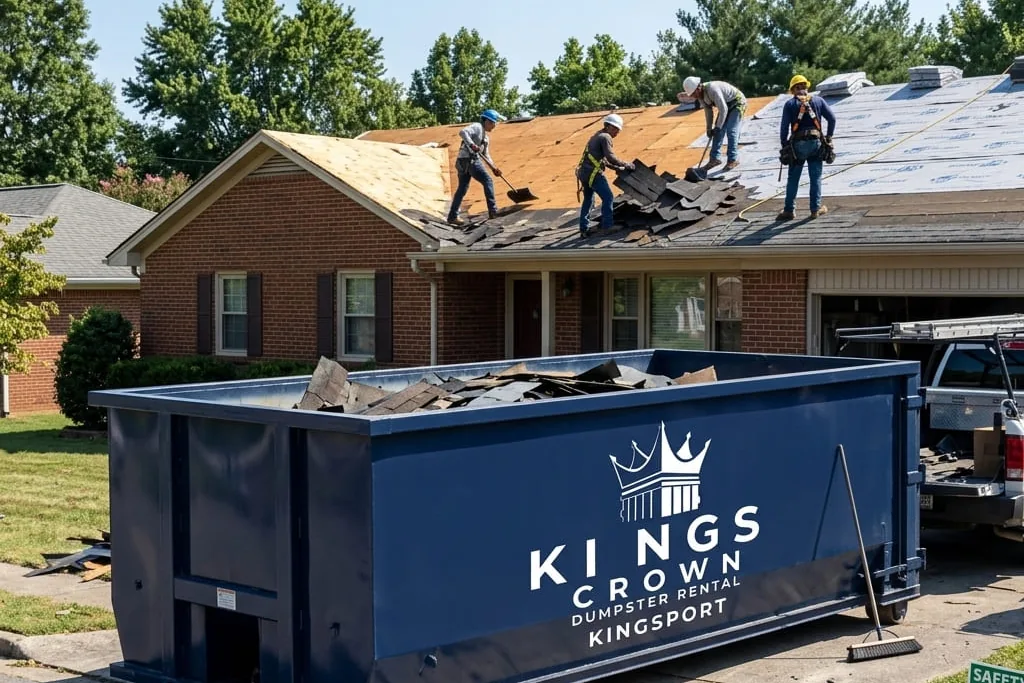
Broken concrete runs near two tons per cubic yard, so a 10 yard box filled level would be roughly twenty tons. That is why heavy boxes load to a line, not the rail. Shingles are usually figured at 230 to 250 pounds per square of single-layer three-tab, so twenty squares is about two and a half tons before you find the second layer; more in our roofing tear-off sizing guide.
Framing scrap, by contrast, runs a few hundred pounds per cubic yard. A 40 yard box full of lumber is well inside its rating while a 10 yard box of masonry is not. On a construction job you hit weight first.
Access and placement on an active site
A roll-off truck needs room to work. For a 30 or 40 yard box, plan on roughly sixty feet of straight, reasonably level approach so the driver can line up, roll the container off the rails, and pull clear. A 10 or 15 yard needs considerably less — a quiet advantage of small heavy boxes on a tight infill lot.
Turning radius matters as much as straight length. A truck that cannot swing wide enough to square up will set the box at an angle that blocks the access the crew needs. Walk the approach the day before and clear it: material stacks, portable toilets, subs' trailers, and stringlines all move easier then than on the morning of.
Look up as well as down. Overhead power service, low limbs, and temporary lighting are a real hazard, because the truck raises its rails high to unload. If the only usable spot sits under a service drop, the box goes elsewhere. Tell us when you book so the driver is not discovering it on arrival.
Protecting what you just paid for
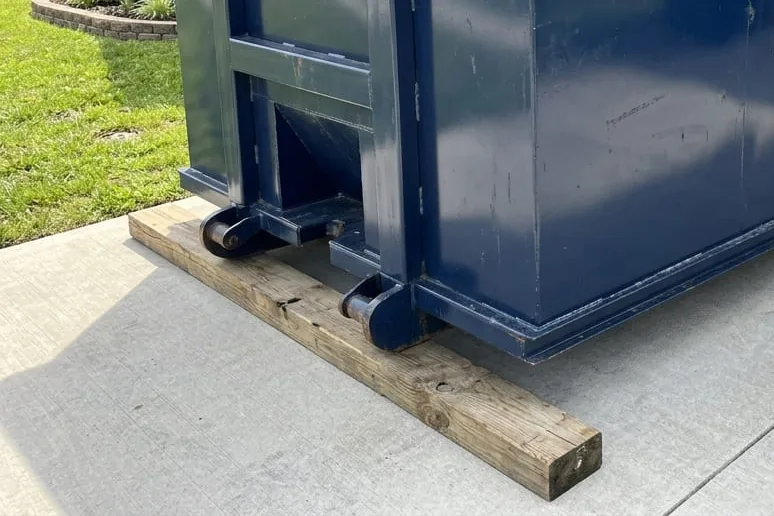
A loaded container concentrates enormous weight into a small footprint, and fresh concrete, new asphalt, pavers, and sod will not survive it. Give new concrete the full cure your mix design calls for, and still lay plywood to spread the load and take the marks. On soft ground after a wet week, put boards under the rails or expect ruts.
Keep the box off sidewalks and out of the public right of way unless you have checked first. Street and right-of-way placement rules are set by the municipality, so confirm with Kingsport or the relevant county office for your address rather than assuming.
Call TN811 before ground work
Any excavation, grading, footing dig, or demolition that disturbs earth requires notice to Tennessee 811 before work starts. Utility owners then mark their lines, and the ticket is valid for a set window before it must be renewed. This is state law, it is free to the caller, and it applies to trenching for a temporary service as much as to a basement dig. Details and the request form are at tenn811.com. Placement deserves the same thought: a loaded box parked over a shallow gas service or a septic field on an unsewered Hawkins County lot can do expensive damage. If the marks land where you wanted the dumpster, move the dumpster.
Swap-out scheduling so a full box never stops a crew
Phase sizing is wasted if the swap does not happen on time. Habits that hold up on real schedules:
Order the swap when the box is roughly three-quarters full, not when it is heaped.
Tie swaps to trade handoffs. The drywall box leaves as the tapers finish, not a week later.
Give the driver a same-day contact who is on site and answers the phone.
Keep the approach clear on swap day, same as delivery day.
On fast phases, run two boxes rather than gamble on one turnaround.
Kingsport was laid out in the late 1910s as one of the country's first professionally planned industrial cities, and much of that early housing stock is still standing and still being renovated. Those buildings bring specific debris problems.
Plaster, lath, and dimensional lumber
Plaster over wood lath is heavy, dusty, and nothing like drywall to handle. Budget a heavy box for it and keep it out of the light bulky stream. True dimensional lumber — actual two-by-fours, full one-inch sheathing — is denser than today's material and often long, so it eats volume and adds weight at once. Cut it down before loading.
Lead paint and asbestos
Assume lead paint in anything painted before 1978 until testing says otherwise; firms renovating those buildings fall under EPA's lead-safe rules. Roughly pre-1980 materials — pipe wrap, floor tile and mastic, some plaster and joint compound, siding, roofing felt — may contain asbestos.
Neither is a judgment call to make on site. Suspect materials must be assessed and, where required, removed by a licensed abatement professional under the applicable notification and disposal rules, and they never go in a general construction container. Start with EPA asbestos guidance and confirm state requirements with TDEC.
What actually goes in the box
Standard construction and demolition debris is straightforward: wood, drywall, roofing, siding, flooring, insulation, fixtures, cabinetry, and packaging. Exclusions are consistent too — liquid paint, solvents, fuels, oils, batteries, refrigerant-bearing appliances, tires, pressurized cylinders, and anything classified as hazardous. Requirements vary by disposal facility and by county, so ask before a questionable material goes in rather than after. Our Tennessee acceptance guide covers the common edge cases.
Plan it once, at the start
Before the first container is ordered, mark where each phase begins and ends. Assign a size to each, decide which streams stay separate, walk the approach, and set the swap triggers. That half hour separates a job where waste is invisible from one where it becomes a daily argument.
For a second set of eyes on a specific schedule, call Kings Crown Dumpster Rental at (423) 830-4153 or reach out here. We serve Sullivan and Hawkins County and the surrounding upper East Tennessee communities. If you are still deciding on a single container, start with our sizing walkthrough.
Kings Crown Dumpster Rental
Written by the team that runs the trucks out of our yard on 2009 Independence Way in Kingsport. We have been hauling
roll-offs across Sullivan County and upper East Tennessee since 2014. Questions about your own job?
Call (423) 830-4153.
Talk to a real person
Ready to book a container in Kingsport?
Call and describe the job. Flat price, stated tonnage, and a delivery time on the same call.
Why should I rent different dumpster sizes for different phases instead of one big container?
Because weight and volume are separate limits. Demolition debris is dense and hits a container's weight rating while the box still looks half empty, while framing and packaging are bulky and light. One container sized for the whole job is oversized during demo, undersized during framing, and sits idle through finish work. Matching each phase to the right box means you pay for capacity when the work actually produces it.
How much clearance does a roll-off truck need on a jobsite?
Plan on roughly sixty feet of straight, reasonably level approach for a 30 or 40 yard container, plus room to swing wide enough to square up on the drop point. Smaller 10 and 15 yard boxes need considerably less. Check overhead clearance too, since the truck raises its rails high to unload, so power service drops and low limbs rule a spot out entirely.
Do I need to call TN811 before a dumpster is delivered?
Tennessee law requires notice to Tennessee 811 before any digging, excavation, grading, or demolition that disturbs earth, so any ground work on your site needs a locate ticket. Delivery of a container itself is not excavation, but a loaded box concentrates serious weight, so it is worth keeping it off shallow services and septic fields. If marks land where you wanted the box, move the box.
Can I mix concrete and brick in with general construction debris?
It is a costly habit. Concrete, brick, block, stone, dirt, and old plaster run near two tons per cubic yard, so a container fills its weight rating long before it fills up. Keeping heavy material in a dedicated low-sided box loaded to the fill line, separate from lumber, drywall, and packaging, moves faster and gives clean masonry a real chance of being crushed and reused.
What should I do about plaster, lead paint, or asbestos in an older Kingsport house?
Plaster and lath is simply heavy debris and belongs in a small heavy box. Lead paint and asbestos are different. Assume paint is lead-based in anything built before 1978 and treat pre-1980 materials like pipe wrap, floor tile, and mastic as possible asbestos until tested. Those must be assessed and handled by a licensed abatement professional, and they do not go in a construction container.
Clearing a parent's house is not a weekend job, and treating it like one produces regret. Here is a paced estate cleanout plan for Kingsport families: the documents pass that comes before anything moves, where people hide things, handling medications and firearms, the four-pile method with room for undecided, and how to stage containers in stages.
Shingles are heavy, flat and dense, so the container that looks big enough is usually the wrong one. Here is how to count squares, allow for hidden second layers, and match a Kingsport roll-off to tonnage instead of cubic yards.
The question homeowners ask last and worry about first. Where a roll-off container's weight really concentrates, why delivery and pick-up are the risky minutes, how asphalt, concrete and gravel each fail, and what to tell your hauler before the truck arrives.