Will a Dumpster Damage My Driveway? Kingsport Guide
The question homeowners ask last and worry about first. Where a roll-off container's weight really concentrates, why delivery and pick-up are the risky minutes, how asphalt, concrete and gravel each fail, and what to tell your hauler before the truck arrives.
8 min readUpdated 2026-04-15By Kings Crown Dumpster Rental
Almost nobody asks it out loud. They ask about size, how many days they get, whether the mattress counts as an extra — then, right at the end, in a slightly different voice: "It's not going to tear up my driveway, is it?" It is the most common unspoken worry a homeowner has before booking a container, and it deserves a straight answer rather than a reassuring one.
Here is the straight answer. A loaded roll-off puts real, concentrated weight on a small part of your driveway, and on some surfaces, in some weather, on some slopes, that weight can leave a mark. Most deliveries leave nothing at all. But "most" is not "all," and the difference comes down to surface condition, timing, and how the driver handles the roll-off and pick-up. Knowing what causes damage removes most of the risk before the truck turns into your street.
Where the weight actually lands
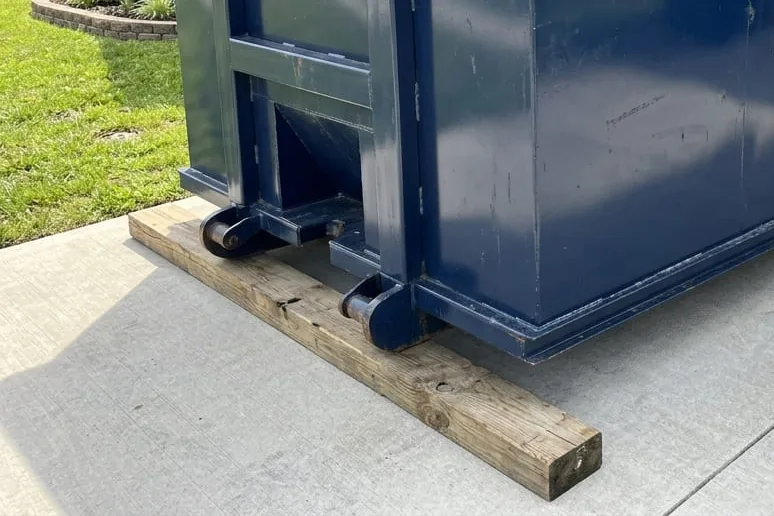
A dumpster does not press down evenly across its footprint. People picture a 20-yard container as a big flat box spreading its weight like a slab. It isn't. Look underneath one and you'll see two long steel rails running front to back, and everything the container weighs — plus everything you put in it — travels down through those two narrow strips of steel.
The rails, not the footprint
Those rails are where pressure concentrates. Fill the box with wet shingles, tile, or broken concrete and the load per square inch under them climbs sharply. It's why a driveway that has parked a full-size truck for a decade can still show marks: the truck spread its weight over four wide tire patches, and the container does nothing of the kind.
The rollers and the touchdown point
The second concentration point is the wheels at the rear of the container and the moment its tail end touches down. During delivery the box tilts off the truck bed and the back end contacts your surface first, sometimes with the whole angle of the container loading onto a couple of small rollers. Those are the highest-pressure seconds of the rental — and it happens in reverse at pick-up, with the container now heavy.
Damage happens in the minutes, not the days
This surprises people. The container sitting on your driveway for a week is not the dangerous phase — static weight on a sound surface, spread onto boards, is usually a non-event. The risk lives in two short windows: the roll-off and the pick-up.
During roll-off the box is moving while in contact with your surface, and movement plus pressure is what scars pavement. During pick-up the winch drags a loaded container up onto the bed, so rails and rollers travel across your driveway under maximum weight, and on a grade the truck's rear tires have to bite hard for traction. If you can be home for the delivery, be home — two minutes of "set it further left, on the concrete apron rather than the asphalt" beats anything else you can do.
Boards under the rails, and why they should be standard
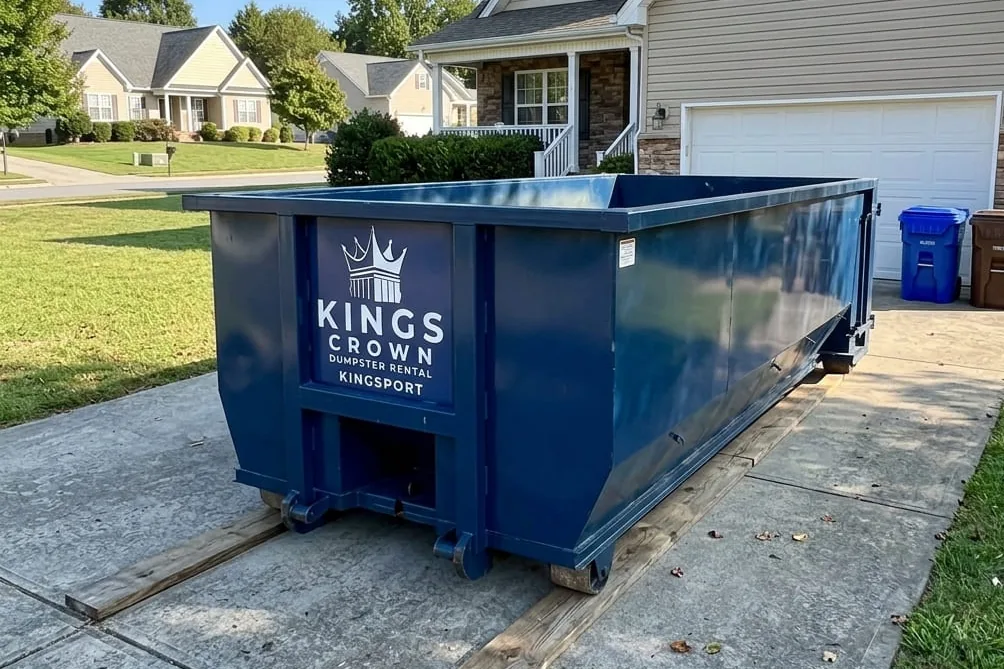
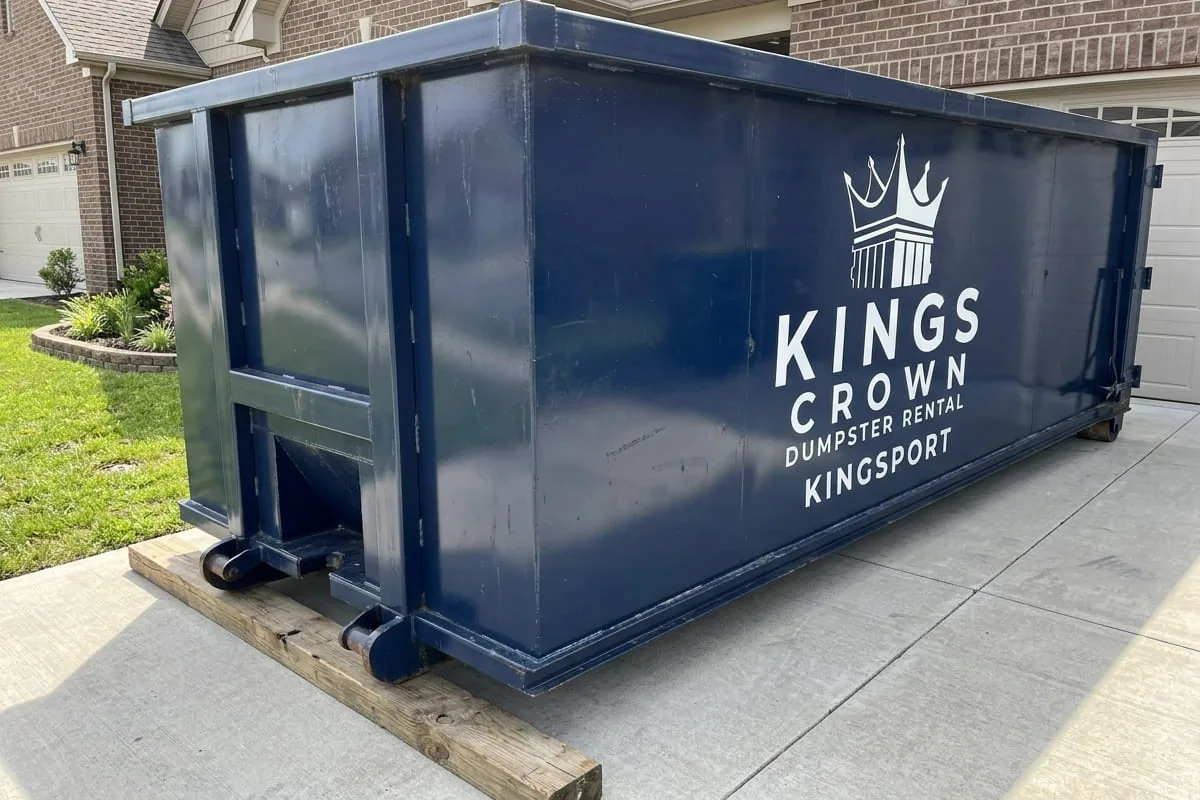
The most effective protection is the simplest: plywood or lumber laid under the rails and at the touchdown point. It turns two narrow high-pressure strips into a wide, low-pressure bearing surface. The load doesn't go away; it stops being concentrated.
Boards should be a default part of a residential delivery, not a paid extra you have to know to ask for. Any hauler treating surface protection as an upsell is telling you something about how they think about your property. If you'd rather use your own plywood, have it out and visible — the driver can't use what's stacked in the garage. One caveat: boards reduce risk, they don't abolish it, and do little for a surface already failing.
How each surface actually fails
Asphalt
Asphalt is a flexible pavement — binder holding aggregate together — and its stiffness depends heavily on temperature. It doesn't crack under a container so much as deform: rails press in and leave depressions, rollers leave short gouges. It is also the surface most likely to keep a permanent shadow of where a container sat.
Concrete
Concrete is rigid, so it doesn't rut. It either handles the load or it cracks. Sound, well-based concrete is the friendliest surface a roll-off can sit on. Failures happen at the edges — the outer few inches of a slab with nothing supporting them are the classic break point — and at cracks and joints, where load widens what was there already.
Gravel and red clay
Gravel doesn't fail; it moves. Rails displace stone and leave troughs, and tires scatter it. The real question is what's underneath. Across much of Sullivan and Hawkins County that's red clay, which after days of rain behaves like something between putty and soup. A drive that's rock solid in August can rut deeply in March, and those ruts are in the subgrade, not the stone.
Surface
Main risk
What prevents it
Flag it when booking?
New or soft asphalt
Rutting under the rails, gouges at touchdown
Full-length boards, cool-hour delivery
Yes, especially if paved this year
Sound concrete
Low; chipping near the slab edge
Boards, placement toward the middle
Not usually
Old or cracked concrete
Cracks widening, corner breakage
Boards spanning cracks, or placement off the slab
Yes
Stamped or decorative concrete
Scuffing, sealer and color damage
Avoid placement; heavy board coverage if unavoidable
Yes, always
Sealcoated asphalt
Scuffing and peeling of the coating
Boards, cooler window
Yes, and say how recently
Gravel over clay
Stone displacement, deep rutting when wet
Dry-day scheduling, firm turnaround
Yes if long, soft, or freshly graded
Pavers or brick
Units shifting or sinking
Placement elsewhere if permitted
Yes, always
Kingsport summers and soft asphalt
East Tennessee summers are hot and humid, and that matters more for asphalt than most people realize. Dark pavement in direct sun runs well above air temperature, so a mid-90s July afternoon leaves a driveway far hotter than the thermometer on your porch suggests. Warmer asphalt is softer, and softer asphalt takes an impression more easily.
The gap between a hot afternoon and a cool morning is worth scheduling around. If your driveway is asphalt and the forecast is a scorcher, ask for an early slot: the pavement cooled overnight and is at its stiffest before the sun has been on it for hours. Freshly laid asphalt is its own category — new pavement keeps curing well after it's laid and is most vulnerable through its first summer. If yours was paved recently, say so and we'll look at the street or a lawn edge instead.
Freeze-thaw, and why condition beats everything
Winters here are mild, but far from static. East Tennessee cycles above and below freezing repeatedly through the cold months rather than freezing hard and staying there, and the cycling is what does the damage. Water gets into a hairline crack, freezes, expands, and widens the void; the next thaw lets more water in. Over several winters, small defects become real ones.
What that means for your booking is simple and slightly uncomfortable: a driveway already cracked, spalling, or crumbling at the edges carries more risk than a sound one, whatever anyone does. Boards spread load; they can't restore a slab that has lost its integrity. If that describes your driveway, the honest advice is to put the container elsewhere — the street, a level patch of yard, a gravel pad — rather than hope.
The higher-risk surfaces worth naming
Sealcoated asphalt looks brand new and is more fragile than it appears. Sealer is a thin surface layer, and scuffing or peeling in it is the most common complaint after a placement on freshly coated pavement. The seal is easier to repair than the asphalt beneath, but know that going in.
Stamped, colored, and exposed-aggregate concrete carries texture, color, and usually a sealer, and all three can be marked; raised relief concentrates contact further than a flat slab. Our recommendation is blunt: don't put a container on it if there's any alternative. Pavers and brick shift and sink individually, and the unevenness is fiddly to fix.
Steep, narrow, and long drives
Plenty of driveways around here aren't flat rectangles. They climb, bend, and narrow between a bank and a retaining wall. When a truck reverses up a grade to set a container, the rear wheels work for traction, and working wheels on warm asphalt scuff. On a steep drive the container also wants to roll, so the driver has to control its descent — another moment of load in motion.
Long gravel drives up the hollows in Hawkins County raise different questions: room to turn around, firmness after recent rain, overhanging limbs, a soft shoulder that will drop a wheel. A call describing the drive beats guessing at it.
What to tell your hauler before the truck arrives
What the surface is — asphalt, concrete, gravel, pavers — and roughly how old.
Whether it has been sealed, stamped, or paved recently.
Existing cracks, soft spots, or areas that hold water.
The grade, the width, and anything overhead.
Exactly where you want it, plus your second-best spot.
What's going in it — heavy debris changes the pick-up weight substantially.
That last point matters most. A container of household clutter and one of concrete or masonry weigh very different amounts at pick-up — when your driveway sees the most load. For heavy debris, a smaller container loaded properly is gentler than a large one filled to the brim — our size guide and the sizing walkthrough cover this, and a 10-yard container is often right for dense material. Roofing is its own case; see the tear-off sizing guide. If the answer is street placement instead, the permit guide explains how that works locally.
If a mark does happen
A hauler worth using doesn't argue. The right response is to come and look in person, promptly, and be honest about whether the placement caused the mark or revealed something already there. Some impressions in asphalt relax over a season; others don't. Either way the conversation should start with someone standing in your driveway looking at what you're looking at, not a phone call insisting it isn't possible.
Ask any hauler two questions before booking: are they insured, and what do they do if they mark a surface. Vague answers are your signal to keep calling. You can read how we work on our about page; the FAQ covers delivery mechanics.
The short version
Most driveways are fine. Risk concentrates in the rails and rollers, and in the minutes of roll-off and pick-up rather than the days between. Boards should be standard, hot afternoons are worst for asphalt, and a cracked surface carries risk no precaution removes. Tell us what you're working with when you get in touch or call (423) 830-4153, and we'll say plainly whether we'd put a container there — and if not, where we would.
Kings Crown Dumpster Rental
Written by the team that runs the trucks out of our yard on 2009 Independence Way in Kingsport. We have been hauling
roll-offs across Sullivan County and upper East Tennessee since 2014. Questions about your own job?
Call (423) 830-4153.
Talk to a real person
Ready to book a container in Kingsport?
Call and describe the job. Flat price, stated tonnage, and a delivery time on the same call.
Sound, properly based concrete handles a roll-off container well and rarely cracks. The risk sits at the edges of a slab, at existing cracks and control joints, and on old or thin pours where the subgrade has washed out. Boards under the rails plus placement toward the middle of the slab remove most of that risk. If your concrete is already cracking or spalling, tell us and we will find a better spot.
Should the driver put boards down under the dumpster?
Yes, and it should not be something you have to request or pay extra for. Plywood or lumber under the container's rails and at the touchdown point spreads a narrow high-pressure load across a much wider area, and it is the single most effective protection available. It reduces risk rather than eliminating it, and does little for a surface already failing, but it should be standard on every residential driveway placement.
Does hot weather really make a difference for asphalt?
It makes a real difference. Asphalt is a flexible pavement whose stiffness depends on temperature, and dark pavement in direct sun runs well above the air temperature. On a hot, humid Kingsport afternoon a driveway can be soft enough to take an impression that the same surface would resist at seven in the morning. If your drive is asphalt and the day looks hot, ask for an early delivery window.
What about a long gravel driveway?
Gravel does not crack, it moves. Rails and truck tires displace stone and leave troughs, which is usually a rake-and-redistribute job. The bigger question is the red clay subgrade underneath, which goes soft after heavy rain and can rut deeply. On long drives up a hollow, tell us about turnaround space, recent rain, soft shoulders, and overhanging limbs before dispatch rather than at the mailbox.
Can I have the dumpster placed on the street instead?
Often yes, and it is the right answer when a driveway is decorative, freshly paved, badly cracked, or too steep to work safely. Street placement may need permission depending on the road and the location, so raise it when you book and we will talk through what applies at your address. Our Kingsport permit guide walks through the general process and who to ask.
Clearing a house does not have to swallow a weekend. Here is a room-by-room cleanout plan built for Kingsport homes, with sizing guidance, the four-pile sorting method, the items that need their own disposal route, and how to stage a steep driveway.
A roll-off does not go to one place. Here is how Tennessee's landfill classes work, which materials have real recycling value or a dedicated route, what must be handled separately, and how to sort a house cleanout so it costs less.
Volume gets the attention, but tonnage decides your size and your bill. A Kingsport-specific guide to 10 through 40-yard roll-offs, the materials that blow a weight allowance, and whether a 30 will even fit up your driveway.