Dumpster Permits in Kingsport, TN: When You Need One
On your driveway, you almost never need a permit. In the street, you usually do, and who you ask depends on whether the City of Kingsport, Sullivan or Hawkins County, a smaller town, or the state controls that road. Here is how to find out before delivery day.
8 min readUpdated 2026-02-17By Kings Crown Dumpster Rental
Most dumpster questions have a quick answer. The permit question makes people pause, because the honest answer starts with another question: where exactly is the container going to sit? Put a roll-off on your own driveway in Colonial Heights and you are almost certainly free to get on with the job. Put the same container in the street outside a narrow row of houses in Lynn Garden and you have stepped onto public ground, and public ground comes with a process.
This guide walks through how that decision gets made around Kingsport and the wider Sullivan and Hawkins County area. We deliberately do not quote fees, code numbers, or turnaround times here; those change, they differ from one authority to the next, and a stale number is worse than none. What we can give you is the shape of the process, the right office to call, and what they will ask the moment you get through. Call Kings Crown Dumpster Rental at (423) 830-4153 to talk through a specific address first.
The basic rule, in one line
If the dumpster sits entirely on property you own or control, you generally do not need a permit from anyone. If any part of it sits on a public street, a sidewalk, an alley, or the right-of-way, you generally do. That single distinction resolves the great majority of jobs we deliver in a given week.
The reason is straightforward. Your driveway or parking lot is your ground, and placing a container on it is your call. A public street is shared infrastructure carrying traffic, emergency vehicles and utility access. Park a loaded steel box on it for a week and the authority responsible wants to know where, for how long, and how it will be visible after dark.
"Right-of-way" is wider than the pavement
This is where people get caught. The public right-of-way usually extends past the edge of the asphalt. Depending on how a street was platted, it can take in the curb, the gutter, the grass strip between sidewalk and street, the sidewalk itself, and sometimes a few feet beyond. Plenty of homeowners placing a container "on the lawn, not the road" are on public ground without realising it. If you are unsure where your lot actually ends, ask before delivery day, not after.
Who controls the road matters more than most people realize
Here is the part that trips up even experienced contractors. "Do I need a permit in Kingsport?" is not really one question. The answer depends on which authority maintains the specific stretch of road in front of the property, and around here there are several possibilities within a few miles.
Inside Kingsport city limits
If the address is inside the city, the city is your first call. Kingsport handles streets and traffic through Public Works, and building, zoning and code matters through its building and development side. Which desk issues a right-of-way or obstruction approval varies with the job, so start at the city's main line and describe it plainly: a roll-off container, this address, on the street, for roughly this many days. They will route you. Start at kingsporttn.gov.
One wrinkle worth knowing: Kingsport straddles the Sullivan and Hawkins county line. A Kingsport mailing address does not automatically mean a property is inside the city limits, and it does not tell you which county you are in. Both facts matter for who you call.
Unincorporated Sullivan and Hawkins County
Outside any city or town, county roads are maintained by the county highway department. Sullivan County runs one; Hawkins County runs one, based in Rogersville. That is the office to ask about a county road right-of-way. Sullivan County's departments are listed at sullivancountytn.gov. Tennessee has no townships, so there is no extra layer here: it is city, county, or state.
The smaller towns
Both counties also contain incorporated towns, including Church Hill, Mount Carmel, Surgoinsville and Bluff City. Each is its own government with its own way of handling street use. If your address is inside one of those town limits, the town hall is the first call, not the county.
State routes
Some of the busiest roads here are numbered state routes, including the US 11W corridor along Stone Drive. Placing anything in a state highway right-of-way generally brings the Tennessee Department of Transportation into it, and a state route running through a city can involve both the state and the municipality. Details are at tn.gov/tdot. In practice we steer customers off state routes and onto a driveway or private lot wherever possible.
Where the container sits
Permit likely?
Who to ask
What they will want to know
Your own driveway or private lot
Usually no
Nobody, unless an HOA or landlord is involved
Nothing, though we will ask about surface and clearance
City street or sidewalk inside Kingsport
Yes, expect one
City of Kingsport
Exact address, container size, start and end dates, traffic and marking plan
County road in unincorporated Sullivan or Hawkins County
Often yes
That county's highway department
Road name, location on the road, duration, how it will be marked at night
Street inside Church Hill, Mount Carmel, Surgoinsville or Bluff City
Often yes
That town's offices
Same basics as a city street
Numbered state route right-of-way
Yes, and it is the hardest one
TDOT, and possibly the city too
Full site detail, sight distance, traffic control, sometimes drawings
Private street in a subdivision or HOA
No city permit, but approval still needed
HOA board or property manager
Dates, size, screening and placement rules
Commercial lot you lease
Usually no
Property owner or manager
Spot on the lot, parking spaces used, dates
What an application usually asks for
Forms differ, but the questions behind them are consistent. Have this ready before you call:
The exact address and a description of the placement, down to which side of the drive and how far from the corner.
The container size, and often its footprint in feet. If you are not sure, our size guide gives dimensions for each option.
Start and end dates. Most authorities want a defined window, and extending usually means asking again.
The responsible party's contact details, which may be you or your contractor, and sometimes insurance information from the hauler.
A sketch or marking plan for a busier road, showing cones, reflectors and how traffic gets past.
How far ahead to start
We will not quote a number of business days, because it genuinely varies by office and by season. The useful rule: start the permit conversation the day the project becomes real, well before you book a delivery. A driveway job can be arranged for tomorrow. A street placement should set your schedule, not get slotted in at the end. Ask the authority what their current turnaround looks like and plan from that answer.
HOAs and subdivision covenants: the approval that bites hardest
Here is the one people forget. A city permit and an HOA approval are separate things, and in newer subdivisions around Kingsport the HOA is frequently the stricter of the two. Covenants can cap how many days a container may stay, require it out of view of the street, restrict deliveries to weekdays, ban placement on a shared drive, or require written board approval in advance.
None of that is enforced by the city. It is enforced by your association, through letters, fines, and occasionally a demand to remove the container before you have finished loading. Read your covenants and get approval in writing before the truck rolls. The same applies to tenants: your lease, not the city, decides whether a container can occupy the lot.
Safety requirements that come with a street placement
When an authority approves a container in the roadway, the attached conditions are about visibility and access: reflective tape or reflectors on the container, cones or barricades at the corners, lighting after dark, and a hard rule against blocking anything critical.
What must stay clear is consistent everywhere: fire hydrants, sight lines at intersections and driveways, crosswalks and curb ramps, storm inlets, bus stops, and the path emergency vehicles need. On the narrow older streets around Church Circle and through Lynn Garden, a container plus the required clearance leaves less usable roadway than people expect, and that alone sometimes decides the answer.
What happens if you skip it
Unpermitted containers in the right-of-way get noticed. The usual sequence is a notice to move it, citations if it stays, and sometimes removal at the owner's expense. Worse, it puts you in a poor position on liability if a vehicle strikes the container or someone is hurt getting around it. A permit is a boring, solvable step; skipping it turns a routine roll-off rental into a risk parked outside your house for a week.
The alternatives worth considering first
Before committing to a street placement, exhaust the options that need no permit at all.
Use the driveway
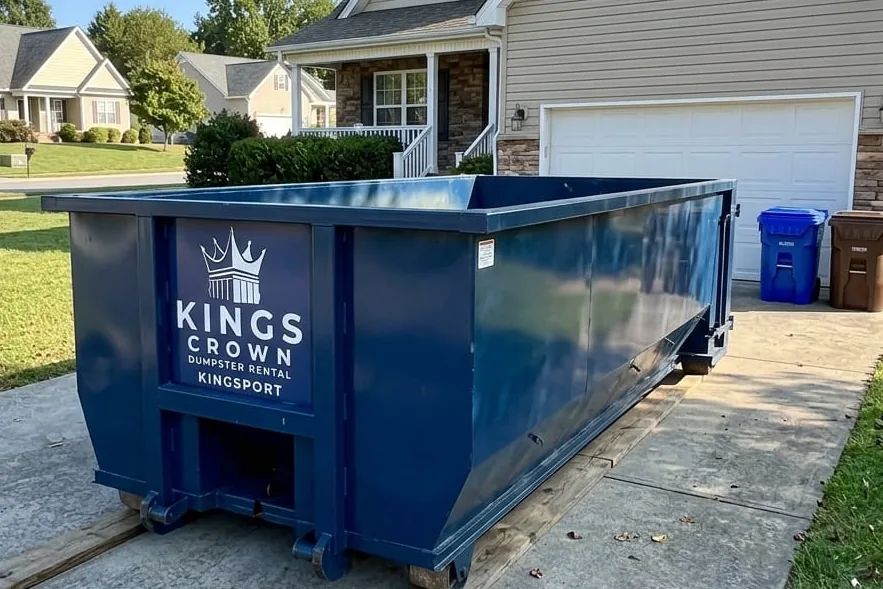
This is the answer most of the time for residential jobs. Drivers handle tight approaches daily and can place a container more precisely than homeowners expect. The usual worry is surface damage, which boards under the rails and a little planning handle; see our guide to protecting your driveway during a rental.
Go smaller
Kingsport's 1916 plan gave the city a walkable, well-organized layout, but the older residential blocks were drawn for far fewer cars than they carry now, and hillside lots often have short, steep drives where the only flat ground is the street. A 10 yard container has a much smaller footprint than a 20 yard and fits driveways the bigger box cannot, sometimes turning a permit job into a no-permit job. Two smaller hauls can beat one large one sitting in the road. Our guide to choosing a dumpster size works through the trade-off.
Borrow a neighbor's space
Out in Hawkins County, long shared gravel drives are common, and placement there is a conversation with the neighbors rather than a government office. Confirm who owns and maintains the drive, check any recorded easement language, and get agreement in writing if more than one household uses it. Gravel takes the weight well; watch for soft ground after heavy rain and whether a loaded truck can turn around.
The short version
On your own ground, go ahead. On public ground, ask first, and ask the right authority, because the city, the counties, the smaller towns and the state each run their own process. Get any HOA sign-off in parallel, not afterwards. And be specific about the address when you call: a Kingsport postal address alone does not tell anyone which government you are dealing with.
We deliver across Sullivan and Hawkins County onto driveways, gravel drives and job sites every week. For a second opinion on whether a spot works without a permit, get in touch or call (423) 830-4153. More questions are answered on our FAQ page.
Kings Crown Dumpster Rental
Written by the team that runs the trucks out of our yard on 2009 Independence Way in Kingsport. We have been hauling
roll-offs across Sullivan County and upper East Tennessee since 2014. Questions about your own job?
Call (423) 830-4153.
Talk to a real person
Ready to book a container in Kingsport?
Call and describe the job. Flat price, stated tonnage, and a delivery time on the same call.
Do I need a permit to put a dumpster in my own driveway in Kingsport?
Generally no. A container sitting entirely on property you own or control does not require a municipal permit, because no public ground is involved. The exceptions are private: a homeowners association, a landlord, or a commercial property owner may still have rules about placement, duration, or visibility. Check your covenants or lease before delivery day, and confirm the driveway has the clearance and surface to take a loaded container.
Who do I call about a permit if the dumpster has to go in the street?
It depends entirely on who maintains that street. Inside Kingsport city limits, start with the City of Kingsport. On a county road in unincorporated Sullivan or Hawkins County, contact that county's highway department. Inside Church Hill, Mount Carmel, Surgoinsville or Bluff City, call that town. For a numbered state route, the Tennessee Department of Transportation is involved, sometimes alongside the city.
How far in advance should I apply for a street placement?
Start as soon as the project is real, and let the permit set your delivery date rather than the other way round. Processing times differ by office and by how busy the season is, so ask the authority directly what their current turnaround looks like and build your schedule from that answer. Driveway placements can usually be arranged quickly; street placements should never be left until the last week.
Can my HOA stop me putting a dumpster on my property?
Often yes, and this catches more people than city permits do. Subdivision covenants can cap how many days a container may stay, require it out of sight of the street, restrict delivery days, or ban placement on a shared drive. Enforcement comes through the association, not the city, and can mean fines or a demand to remove it early. Get board approval in writing beforehand.
What safety equipment is required when a dumpster sits on a public street?
Expect conditions built around visibility and access. Common requirements include reflectors or reflective tape on the container, cones or barricades at the corners, and lighting after dark. The container must not block fire hydrants, sight lines at intersections and driveways, crosswalks, curb ramps, storm inlets, or emergency access. The permitting authority will tell you exactly what applies to your street.
Wind, hail, ice, and tropical remnants all hit upper East Tennessee. Here is the order to do storm cleanup in, what to photograph for insurance, how to sort debris so it does not cost more, and how to size a container for saturated material.
Running waste on an active jobsite is a scheduling problem, not a trash problem. Here is how Kingsport contractors size roll-off containers by build phase, keep heavy debris separate from light bulky debris, and plan access so a full box never stops a crew.
Clearing a parent's house is not a weekend job, and treating it like one produces regret. Here is a paced estate cleanout plan for Kingsport families: the documents pass that comes before anything moves, where people hide things, handling medications and firearms, the four-pile method with room for undecided, and how to stage containers in stages.