
Weight, not volume
Concrete & Heavy Debris Dumpster Rental Kingsport TN
Concrete, brick, block, soil and asphalt are the heaviest things anyone puts in a container. These loads are limited by weight long before they are limited by space, so the right answer is a small box filled part way, not a large one filled up.
- Licensed & insured
- Same-day delivery
- Flat-rate pricing
- Locally owned
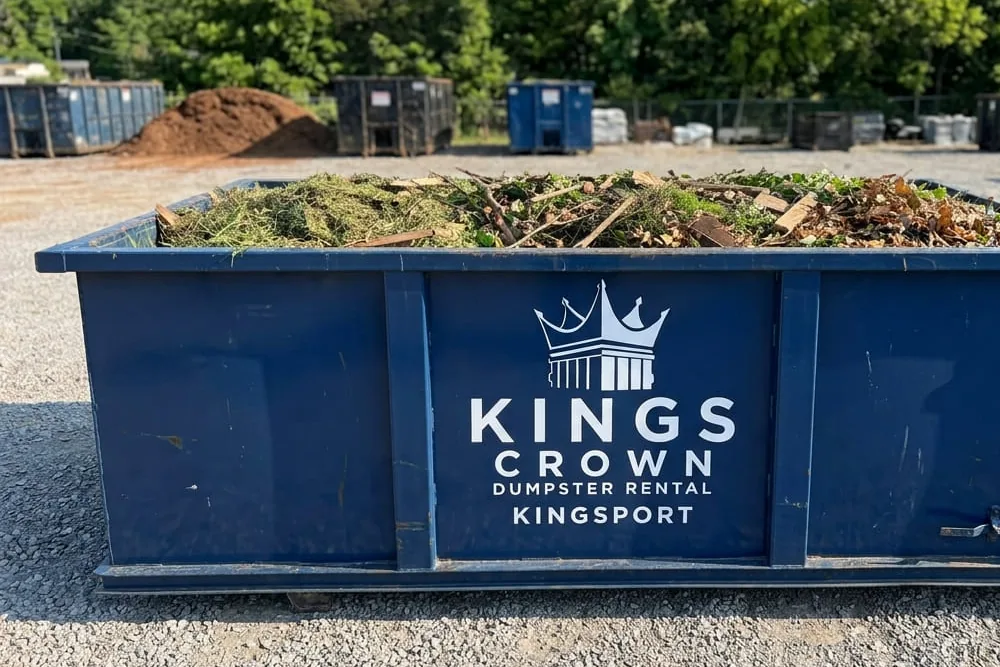
Concrete & Heavy Debris Dumpster Rental Kingsport TN across Kingsport and Sullivan County
Heavy debris follows completely different rules from everything else on this site. With household clutter or framing scrap, you fill the container and it goes. With concrete, brick, block, soil, asphalt or stone, the container reaches its weight allowance while it still looks close to empty, and a box loaded past that point simply cannot be picked up.
Kings Crown Dumpster Rental handles heavy debris throughout Sullivan and Hawkins counties: driveway and patio removals, sidewalk and step demolition, retaining wall tear-outs, chimney removals, footing and foundation breakouts, and excavation spoil. What matters most on these jobs is an honest conversation about tonnage before the container arrives.
What Counts as Heavy Debris
The category is broader than people assume, and mixing any of it into a general load can put that load over weight on its own.
- Concrete, whether reinforced or plain, including slab, footings and steps
- Brick, block, stone, mortar and chimney rubble
- Asphalt from driveways and parking areas
- Soil, clay, gravel, sand and excavation spoil
- Ceramic and porcelain tile, mortar bed and old plaster in quantity
Red clay deserves a specific mention here because it is everywhere in this region. Dry clay is heavy. Wet clay is dramatically heavier, and it will not drain out of a container. If you are removing soil after a wet spell, expect the tonnage to run well above what a dry-weather estimate suggests, and consider tarping the container between working days.
Why a Small Container Is the Right Choice
The instinct on a big job is to order a big container. With heavy debris that instinct is wrong and it can leave you with a box that has to be partly unloaded by hand before the truck can take it. A 10 or 15 yard container is the correct tool, and if the volume exceeds one box, the answer is more boxes rather than a bigger one.
| Size | Dimensions | Weight allowance | Suitability for heavy debris |
|---|---|---|---|
| 10 yard | 12ft x 8ft x 3.5ft | 1 to 2 tons | Best choice, low walls make hand loading practical |
| 15 yard | 16ft x 8ft x 4ft | 2 to 3 tons | Good for larger breakouts and machine loading |
| 20 yard | 22ft x 7.5ft x 4.5ft | 3 to 4 tons | Only with strict fill limits agreed in advance |
| 30 yard | 22ft x 8ft x 6ft | 4 to 5 tons | Not suitable, would be overweight at shallow depth |
| 40 yard | 22ft x 8ft x 8ft | 5 to 6 tons | Not suitable for dense material |
Low walls are an underrated advantage. A 10 yard box at three and a half feet tall can be loaded by wheelbarrow or by hand over the side. A 30 yard at six feet cannot, which means everything has to go through the rear door regardless of where the work is. Full details on each container are on the 10 yard page and the sizes index.
Clean Loads and Why They Matter
A container holding nothing but clean concrete, brick and block is handled differently from a mixed load, because clean masonry has recycling outlets that mixed debris does not. Crushed concrete has genuine value as aggregate. That option disappears the moment someone throws in a bag of drywall offcuts or a length of carpet.
If you are doing a driveway removal, keep the concrete container strictly for concrete and put the forms, stakes, plastic sheeting and general jobsite waste somewhere else. It is a small discipline that changes how the load is handled and often what it costs. For mixed structure work, our demolition debris service is the better fit, and for jobsites needing both, we can place two containers.
Loading, Access, and Ground Conditions
Heavy debris concentrates load in a small area, which makes placement more sensitive than usual. A container holding two tons of concrete in its first three feet puts serious pressure on whatever is underneath, and on a hot asphalt driveway in July that can mean impressions that do not come out.
Practical measures for these jobs:
- Place on the firmest available surface, and ask for boards under the rails if the surface matters
- Load flat and spread along the length rather than piling at the door end
- Break large slab sections down so they lie flat instead of bridging
- Keep rebar and mesh contained rather than protruding over the rails
- Call 811 for utility locates before breaking any slab that might sit over a service
That last point is not a formality. Water services, gas lines and electrical runs pass under driveways and patios routinely, and locates need to be requested before excavation begins in Tennessee. It costs nothing and it is the difference between a normal day and a very bad one.
Estimating Tonnage Before You Order
You can get a usable estimate before ordering. Measure the area in square feet, multiply by the thickness in feet to get cubic feet, then divide by 27 for cubic yards. As a working rule, a cubic yard of broken concrete runs on the order of two tons, and soil is in a similar range depending on moisture. A ten by twenty foot patio at four inches thick is about two and a half cubic yards, which is already several tons.
Run that number before you book and the conversation gets much easier. Call (423) 830-4153 with the dimensions and we will work it through with you, or read what can go in a dumpster in Tennessee for the wider list of what is and is not accepted.
Which size suits the job
Use a 10 or 15 yard container and nothing larger. The 10 yard at 12ft by 8ft by 3.5ft carries one to two tons and its low walls allow wheelbarrow loading over the side. Weight decides everything here: a 30 yard box would exceed its allowance at shallow depth, so more small containers always beats one big one.
- Concrete, brick, block, stone and mortar rubble
- Asphalt, soil, clay, gravel and excavation spoil
- Small 10 and 15 yard containers matched to weight limits
- Clean masonry kept separate for aggregate recycling
- Tonnage estimates worked through before you book
Sizes
Which container for concrete & heavy debris?
Every service runs in all four sizes. Match the material to the weight allowance and the rest takes care of itself.
| Size | Dimensions | Capacity | Weight included | Best for |
|---|---|---|---|---|
| 10 Yard Dumpster | 12 ft long × 8 ft wide × 3.5 ft high | about 3 pickup truck loads | 1–2 tons | Small bathroom remodels, single-room cleanouts, concrete and heavy debris, roofing up to about 15 squares. |
| 15 Yard Dumpster | 16 ft long × 8 ft wide × 4 ft high | about 4–5 pickup truck loads | 2–3 tons | Basement and attic cleanouts, kitchen remodels, medium roof tear-offs, small deck removals. |
| 20 Yard Dumpster | 22 ft long × 7.5 ft wide × 4.5 ft high | about 6 pickup truck loads | 3–4 tons | Whole-home decluttering, flooring and siding jobs, large tear-offs, drywall and mud phases. |
| 30 Yard Dumpster | 22 ft long × 8 ft wide × 6 ft high | about 9 pickup truck loads | 4–5 tons | Full-house renovations, new construction, estate clearances, commercial fit-outs and demolition. |
| 40 Yard Dumpster | 22 ft long × 8 ft wide × 8 ft high | about 12 pickup truck loads | 5–6 tons | Large commercial fit-outs, industrial clear-outs, major renovations and high-volume light debris. |
Talk to a real person
Need concrete & heavy debris in Kingsport?
Call (423) 830-4153 and describe the job. You will get a flat price and a delivery time on the same call — most orders before noon go out the same day.
Mon–Sat 7:00am – 6:00pm · Sun by appointment
Answers
Concrete & Heavy Debris — your questions
Why can I not put concrete in a 30 yard dumpster?
Because it would be far too heavy to move. A 30 yard container carries roughly four to five tons, and broken concrete runs on the order of two tons per cubic yard, so the box would be over its allowance at a couple of feet deep. A container loaded past its limit cannot legally or safely be hauled, and it has to be partly unloaded by hand.
How do I estimate how much concrete I have?
Measure the area in square feet, multiply by the thickness in feet to get cubic feet, then divide by 27 for cubic yards. As a working rule, allow about two tons per cubic yard of broken concrete. A ten by twenty foot patio at four inches thick is roughly two and a half cubic yards, which is already several tons of material.
Does the concrete need to be clean?
It does if you want the benefit. Clean concrete, brick and block have recycling outlets that mixed debris does not, and crushed concrete has real value as aggregate. One bag of drywall offcuts or a roll of old carpet turns the whole load into mixed waste. Keep forms, stakes, sheeting and general jobsite debris in a separate container.
Can rebar stay in the concrete?
Reinforced concrete is generally fine, since most breakouts include some steel. What causes problems is loose rebar or mesh protruding above the container rails, because the load has to be tarped for transport. Cut long pieces down and keep everything below the top rail. If you have a large quantity of loose steel, it is worth setting aside as scrap.
Can you put the container on my driveway for a concrete job?
Usually, but heavy debris concentrates weight in a small area and that makes the surface matter more than normal. Hot asphalt in midsummer can take lasting impressions, and soft red clay under gravel will rut. We place boards under the rails on request and will suggest a firmer spot if one exists. Tell us the surface when you book.
Service area
Concrete & Heavy Debris across upper East Tennessee
We run roll-off dumpsters out of our 2009 Independence Way yard across Sullivan County and Hawkins County — from the older streets of Lynn Garden and Colonial Heights out to Bloomingdale and Rock Springs, west on 11W to Church Hill and Rogersville, and down I-81 toward Blountville, Bristol and Johnson City. If your town is not on this list, call us anyway. We probably still get there.