Clearing a house does not have to swallow a weekend. Here is a room-by-room cleanout plan built for Kingsport homes, with sizing guidance, the four-pile sorting method, the items that need their own disposal route, and how to stage a steep driveway.
8 min readUpdated 2026-04-20By Kings Crown Dumpster Rental
Most home cleanouts in Kingsport don't stall because the job is too big. They stall because somebody opens a box of photographs on Saturday morning and the next four hours disappear. The physical work of clearing a house is genuinely manageable over a weekend or a long week. The decision-making is what eats the clock, and the only reliable fix is to decide the order of operations before the container ever lands in the driveway.
This is a room-by-room plan built around how houses around here are actually put together. Nearly everything in Kingsport's older housing stock has either a full basement or a crawlspace, and a lot of it has a detached garage out back. That is where the real volume hides — not in the bedrooms everyone worries about. Work the plan below and you will spend your weekend carrying things instead of standing still holding them.
Start With the Size, Not the Schedule
Sizing a container for a cleanout is a different exercise from sizing one for a remodel. With a remodel you can measure the material. With a cleanout you are estimating loose household volume, which compresses badly and fills faster than people expect.
A workable rule of thumb: count the rooms you intend to empty, then adjust hard for contents. A two-bedroom house with sparse furnishings and a dry basement is a different job from a two-bedroom house where the basement has been the family storage unit since the Nixon administration.
Rooms being cleared
Typical contents
Starting size
Bump up a size if
1-2 rooms, light
Clothing, boxes, small furniture
10 yard
Any bulk furniture is going in
3-4 rooms, average
Beds, dressers, general household
15 yard
There is a basement or attic in scope
Full small house
All furnishings plus storage
20 yard
Detached garage is included
Full house, decades of storage
Everything, plus basement and garage
30 yard
Damp carpet, saturated cardboard, shelving
Large house or multi-day estate job
Whole-property clearance
30-40 yard
You want one pull instead of two
Weight matters as much as volume. Our containers carry roughly 1-2 tons on a 10 yard, 2-3 tons on a 15, 3-4 on a 20, 4-5 on a 30 and 5-6 on a 40. Household goods rarely test those limits — until humidity does. A Kingsport summer means basement carpet, padding and stacked cardboard that have been quietly absorbing moisture for years. Damp carpet can weigh double what a dry roll weighs, and a wall of soggy boxes will surprise you on the scale. If the lower level has ever taken water, size up rather than gambling on it. Our container size guide lays the dimensions out side by side, and the sizing walkthrough for Kingsport homes goes deeper on the judgment calls.
Work Bottom-Up and Outside-In
The instinct is to start with the kitchen, because the kitchen looks like progress. Resist it. The kitchen is the single worst room to open first: it is dense with small decisions, half its contents are things somebody might want, and clearing it does nothing to create the staging room you need for everything else.
Start in the basement or the detached garage instead, for three reasons.
1. That is where the volume actually is
Basements and garages hold the bulk items — shelving, old appliances, lumber offcuts, lawn equipment, furniture that got demoted rather than discarded. Clearing them first tells you within a couple of hours whether you sized the container correctly, while there is still time to adjust.
2. Those decisions are easy
Nobody agonises over a rusted shelving unit. Starting with low-emotion items builds momentum and gets the household into a rhythm before anyone reaches the boxes of letters.
3. It creates working space
An empty garage bay is the best sorting floor you will get. Once it's clear, upstairs rooms can be emptied straight into staging zones rather than shuffled around the house.
From the basement or garage, work upward and inward: outbuildings, then lower level, then main-floor living areas, then bedrooms, then the kitchen, then bathrooms last. Save the attic for a cool part of the day — August in a Kingsport attic is genuinely unsafe past mid-morning.
The Four-Pile Method
Every item gets sorted exactly once, into one of four destinations. No fifth pile, no "decide later" corner — that corner becomes a room by Sunday.
Keep. Goes directly to a labelled staging area, not back where it came from.
Sell or donate. Must be clean, functional and something a stranger would actually take. If you're arguing for it, it isn't.
Recycle or take separately. The special-handling pile — everything covered in the next section.
Container. Everything else, loaded as you go rather than stockpiled.
The discipline that makes this work is the one-touch rule. An item leaves your hand at its destination, not on the floor between piles. Set a timer for genuinely hard calls: sixty seconds, then it goes to sell/donate by default. And do the sentimental boxes on a separate evening, deliberately, with nothing else scheduled. Mixing memory work into a cleanout weekend is how weekends die. If you're clearing a family home after a death, our estate cleanout checklist and estate cleanout service handle that situation specifically.
What Cannot Go in the Container
This pile is small but non-negotiable. Sort it into its own corner of the garage on day one so nothing gets buried and nothing goes in the container by accident.
Paint. In Tennessee it is illegal to put wet latex paint in a landfill. Latex can be dried out solid — lid off, or mixed with an absorbent — and then handled as regular trash. Oil-based paint cannot go in the trash at all and must be managed as household hazardous waste.
Solvents, thinners, adhesives, pool chemicals, pesticides. Household hazardous waste, every time.
Fuel and automotive fluids. Gasoline, mixed fuel from the string trimmer, antifreeze, used oil. Antifreeze in particular should never go on the ground, down a storm drain or into a septic system.
Propane cylinders. Grill tanks and camp cylinders stay out, full or empty. Many are exchangeable where you bought them.
Batteries. Lithium and lithium-ion batteries must be kept out of both trash and mixed recycling — they start fires in collection trucks and at sorting facilities. Lead-acid car and mower batteries are recycled separately.
Fridges, freezers, window units, dehumidifiers. Anything with a sealed refrigerant system needs the refrigerant recovered by a certified technician before it can be scrapped. Set them aside; don't roll them into the container.
Electronics. TVs, monitors and computers go through electronics recycling rather than the container.
Tires. Tennessee prohibits disposing of whole, unshredded tires in landfills. Every county is required to provide at least one waste tire collection site.
Tennessee runs a statewide household hazardous waste program with mobile collection events scheduled in spring and autumn, plus year-round facilities in a handful of counties. Because Sullivan and Hawkins are not among the permanent-facility counties, most Kingsport households use either a scheduled mobile event or their county or city convenience center, which typically take batteries, used oil, paint, antifreeze and electronics. Check current dates and locations with TDEC or your county solid waste office before the cleanout weekend, and see EPA's household hazardous waste guidance for safe storage and transport. Our local recycling and disposal guide collects the routes in one place, and what can go in a dumpster in Tennessee covers the container rules in full.
Pull the Valuable Things Out First
Some things are worth ten minutes of attention before they end up at the bottom of a 30 yard container.
Scrap metal. Steel shelving, cast-iron radiators, copper pipe, aluminum storm windows, appliance carcasses, cable and wire. Basements and detached garages around here are full of it. Stage metal separately from the start.
Appliances. Working units have resale or donation value. Non-working steel appliances are scrap. Either way, they should not be the first thing loaded.
Tools, furniture and fixtures. Hand tools, solid-wood furniture, period light fixtures and hardware routinely have real value. So do intact building materials from a garage — full sheets, unopened boxes of tile, decent lumber.
Pacing: Weekend Versus Week
A two-day weekend realistically covers a small house or apartment, or the basement-and-garage half of a larger one, provided at least two people are working and the container is already on site Friday. Expect Saturday to be volume and Sunday to be detail.
A full four-bedroom house with a finished basement, a detached garage and forty years of accumulation is a week, not a weekend. Plan roughly one major zone per day: garage, basement, main floor, bedrooms, kitchen and baths, then a final sweep. Sequencing that over five or six days beats two exhausting days followed by three weeks of unfinished piles. If the pace slips, a crew doing the loading can compress it, and a fast swap-out covers the case where you underestimated and need a second container.
Staging the Driveway
Kingsport driveways are often short, often steep, and frequently the only flat working surface on the property. Plan the space before delivery day.
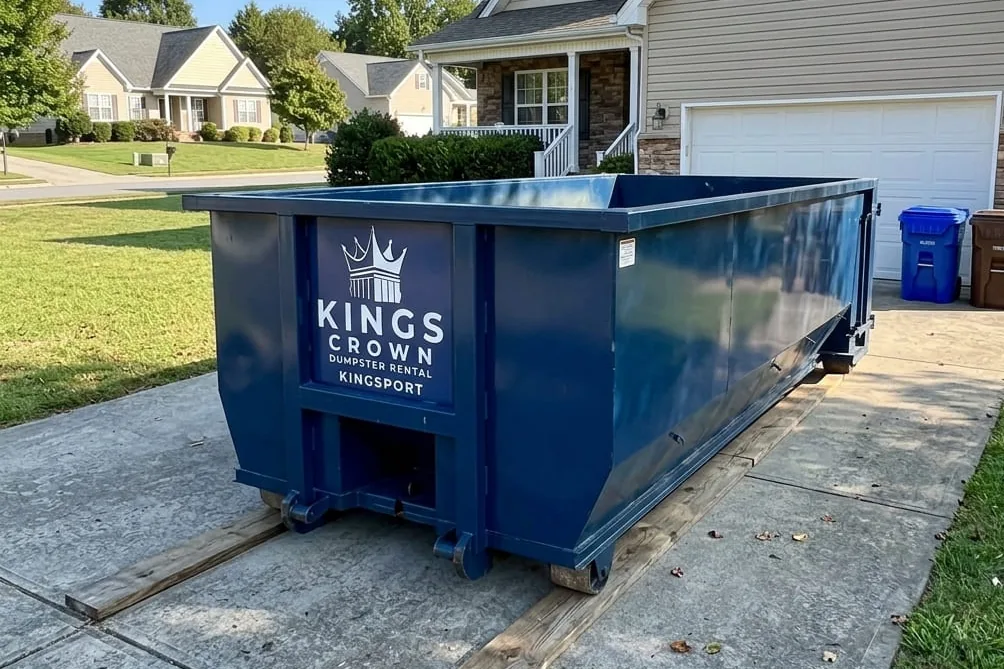
Work out three zones: the container, the donation and sell staging area, and room for at least one vehicle you still need to use. Put the container closest to the main exit door — every extra step gets multiplied by several hundred trips. Give the truck a clear straight approach with about 60 feet of run and overhead clearance free of low limbs and utility lines. Keep the container off the street where possible so nothing depends on parking rules or right-of-way questions.
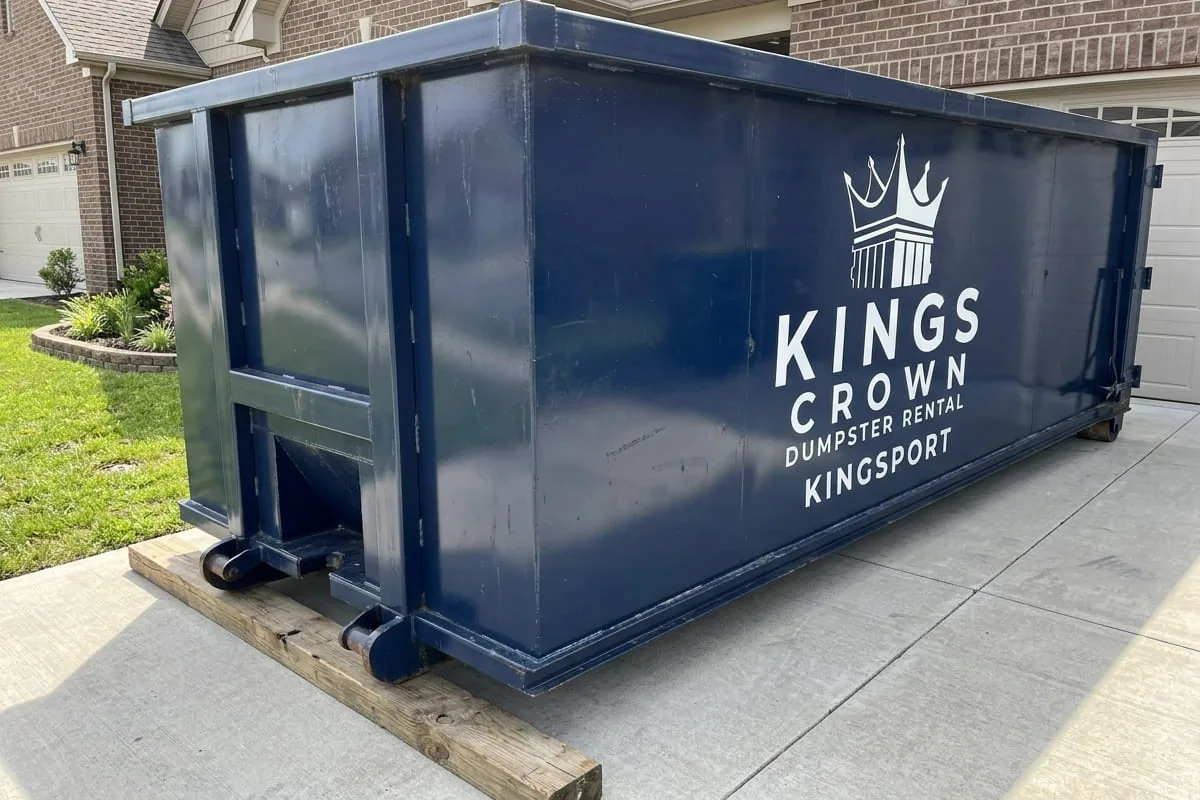
On a sloped drive, position across the slope rather than nose-down, and never load the far end heavy on a grade. Lay plywood or boards under the rails and rollers to spread the load and protect the surface — our notes on protecting your driveway cover that in detail. Keep the donation pile under cover or tarped; a summer thunderstorm turns donatable furniture into container fill in about twenty minutes.
Load heavy and flat items first, break down anything that can be broken down, and fill corners as you go rather than tossing into the middle. A container packed deliberately holds noticeably more than one packed in a hurry on Sunday afternoon.
Get the Container Sorted
The plan is simple: size for the rooms and the contents, start low and outside, sort once into four piles, keep the special-handling items out from the beginning, and stage the driveway so nothing blocks anything else. Kings Crown Dumpster Rental delivers throughout Sullivan and Hawkins County. Call (423) 830-4153 or get in touch to talk through the right size for your house, and see our full range of residential container services.
Kings Crown Dumpster Rental
Written by the team that runs the trucks out of our yard on 2009 Independence Way in Kingsport. We have been hauling
roll-offs across Sullivan County and upper East Tennessee since 2014. Questions about your own job?
Call (423) 830-4153.
Talk to a real person
Ready to book a container in Kingsport?
Call and describe the job. Flat price, stated tonnage, and a delivery time on the same call.
What size dumpster do I need for a full house cleanout in Kingsport?
For a full small house, a 20 yard container is the usual starting point. Add a detached garage or a basement full of long-term storage and a 30 yard is the safer call. The deciding factor is rarely the bedrooms — it is whether the lower level and outbuildings are in scope, and whether anything down there has taken moisture. Damp carpet and saturated cardboard add far more weight than people expect.
Why should I start in the basement or garage instead of the kitchen?
Three reasons. The basement and garage hold most of the actual volume, so clearing them early tells you whether you sized the container right while you can still adjust. The decisions there are easy, which builds momentum before anyone reaches sentimental items. And an emptied garage bay gives you the best sorting floor on the property for everything that comes down from upstairs.
What has to stay out of the dumpster during a cleanout?
Paint, solvents, thinners, pesticides and pool chemicals, fuel and automotive fluids, propane cylinders, batteries, electronics, tires, and anything with a sealed refrigerant system such as a fridge, freezer or window air conditioner. Tennessee prohibits whole tires in landfills and wet latex paint in landfills. Set these aside on day one so they do not get buried under the rest of the load.
Where do Kingsport residents take household hazardous waste?
Tennessee runs a statewide household hazardous waste program with mobile collection events in spring and autumn, plus permanent facilities in a small number of counties that does not include Sullivan or Hawkins. Most local households use a scheduled mobile event or a county or city convenience center, which generally accept batteries, used oil, paint, antifreeze and electronics. Confirm current dates and locations with TDEC or your county solid waste office.
Can a house cleanout realistically be finished in one weekend?
A small house or apartment, or the basement and garage portion of a larger home, is a genuine two-day job with at least two people working and the container delivered Friday. A four-bedroom house with a finished basement and a detached garage is a week. Plan one major zone per day rather than trying to compress it into two exhausting days followed by weeks of leftover piles.
A roll-off does not go to one place. Here is how Tennessee's landfill classes work, which materials have real recycling value or a dedicated route, what must be handled separately, and how to sort a house cleanout so it costs less.
Volume gets the attention, but tonnage decides your size and your bill. A Kingsport-specific guide to 10 through 40-yard roll-offs, the materials that blow a weight allowance, and whether a 30 will even fit up your driveway.
A roll-off has no shelf price. Here is how Kingsport dumpster pricing is actually built, what a true flat rate includes, and how to compare quotes without getting caught by weight overage.