Shingles are heavy, flat and dense, so the container that looks big enough is usually the wrong one. Here is how to count squares, allow for hidden second layers, and match a Kingsport roll-off to tonnage instead of cubic yards.
8 min readUpdated 2026-03-10By Kings Crown Dumpster Rental
A roof tear-off is the one job where the container that looks right is almost always the wrong one. Shingles are dense, flat and unforgiving: a pile that barely covers the floor of a 30 yard box can weigh more than the same box is rated to carry. Homeowners and crews around Kingsport tend to size a roofing container the way they'd size one for a garage clean-out, by imagining how much space the debris will take up. That instinct works for furniture and drywall. It fails badly for asphalt.
The number that decides your rental is tonnage, not cubic yards. Every roll-off carries a weight allowance, and on a tear-off you hit it long before the walls are full. This guide covers the unit roofers actually use — the square — how to estimate squares from a footprint and pitch, what a square weighs, how a second layer rewrites the maths, and why the box that looks safer often isn't. For mixed debris, see our Kingsport sizing guide.
The Roofing Square Is the Unit That Matters
A roofing square is 100 square feet of finished roof surface. Every estimate, every material order and every disposal calculation in the trade runs on squares, and once you start thinking in squares the weight question becomes answerable. A typical single-story ranch in the older Kingsport neighborhoods might be 18 to 24 squares. A two-story with dormers and a garage wing can easily run 30 to 40.
Estimating Squares From Footprint and Pitch
You don't need to climb up to get a workable number. Start with the building footprint — the outside dimensions of the house including any attached garage or porch that shares the roof. Multiply length by width to get the plan area in square feet, then add roughly 8 to 12 percent for eave and rake overhangs, which are real roof surface even though they sit outside the walls.
Then correct for pitch, because a roof surface is always larger than the ground it covers. As rough multipliers: a 4/12 adds around 5 percent, a 6/12 about 12 percent, an 8/12 roughly 20 percent, and a steep 10/12 or 12/12 can add 30 to 40 percent. Divide by 100 for squares.
A worked example: a 30 by 45 foot house is 1,350 square feet of footprint. Add 10 percent for overhangs and a 6/12 pitch multiplier of about 1.12 and you get roughly 1,663 square feet — just under 17 squares. Add an attached garage and you're near 22.
What a Square of Shingles Weighs
These are typical industry figures and they vary meaningfully by manufacturer, product line and how much moisture and grit the roof has absorbed over its life — treat them as ranges to plan around, not fixed numbers.
Three-tab asphalt shingles, the thin flat product on most roofs installed before the mid-2000s, generally run somewhere in the region of 200 to 250 pounds per square. Architectural or dimensional shingles — the laminated ones with the layered shadow line that dominate replacements now — are heavier, commonly in the 250 to 400 pound per square range, with premium and impact-rated lines sitting at the top end or above it. Heavier designer and luxury profiles can exceed that again.
So a 22 square tear-off of single-layer three-tab lands around 4,400 to 5,500 pounds. The same 22 squares in heavy architectural could be 5,500 to 8,800 pounds. That is the whole difference between sitting inside a 20 yard allowance and blowing past it — and it is invisible from the ground.
How a Second or Third Layer Changes Everything
This is where Kingsport's older housing stock bites. Plenty of homes here have had a second layer laid straight over a tired first one at some point in the last forty years, and a few have three. Each additional layer is not a small increment — it is a full multiple. Two layers of architectural over a 25 square roof is not 25 squares of debris, it is 50 squares of debris, and the maths doubles accordingly.
Check before you book. Lift a shingle at a rake edge and count the distinct courses stacked at the drip edge. If you genuinely can't tell, plan for a second layer and arrange a swap rather than gambling on one container.
Sizing Table: Squares, Layers, Weight and Container
Roof size
Layers
Estimated weight range
Recommended container
12–15 squares
1
1.2–3.0 tons
15 yard (2–3 t); 10 yard only if light three-tab
16–22 squares
1
1.6–4.4 tons
20 yard (3–4 t)
23–28 squares
1
2.3–5.6 tons
20 yard if three-tab; 30 yard (4–5 t) if architectural
16–22 squares
2
3.2–8.8 tons
30 yard plus a likely swap, or two staged 20 yards
23–28 squares
2
4.6–11.2 tons
Two or more staged pulls — plan the swap up front
28+ squares
2–3
7 tons and up
Multiple staged containers on a scheduled swap cycle
Add roughly 5 to 10 percent on top of every figure above for felt, nails and old flashing. If any decking is coming off, add more again.
Why a 20 Yard Usually Beats a 30 on a Tear-Off
The 30 yard looks like the safe choice. It's a 22 by 8 foot box with six-foot walls, and the extra capacity feels like insurance. On a roofing job it usually isn't, for three reasons.
First, the tonnage allowance is what you're really buying, and the step from a 20 yard at 3–4 tons to a 30 yard at 4–5 tons is a single ton. The volume nearly doubles; the weight allowance barely moves. You pay for air you cannot legally fill with shingles.
Second, throw height. A 20 yard sits at about four and a half feet — a crew on a one-story eave pitches shingles over the rail cleanly. A 30 yard's six-foot walls mean more debris hits the side and bounces onto the driveway.
Third, footprint. East Tennessee driveways are often steep, narrow and hemmed in by cut banks or retaining walls, and a loaded roll-off on a grade is harder to hook the bigger it gets. Our size comparison has the dimensions side by side.
The right move on a big or multi-layer tear-off is not a bigger box — it's a second pull. Two 20 yard loads give you eight tons of allowance against the 30's five, and the container is never sitting there too heavy to move.
Placement: Get It Tight to the Eave
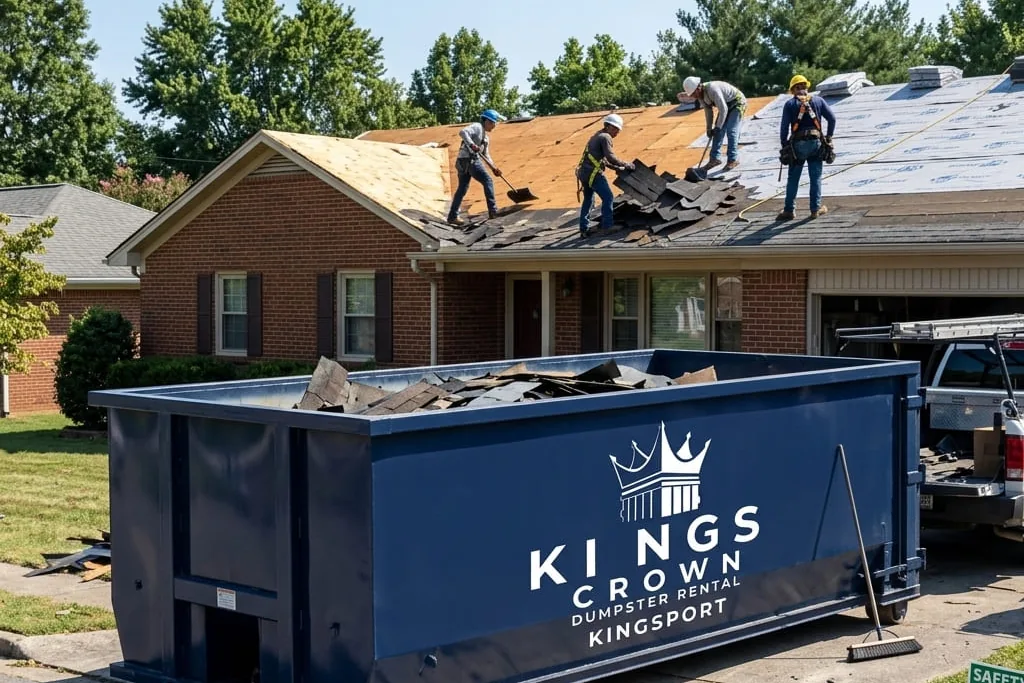
The single biggest labor saving on a tear-off is putting the container where the shingles can fall into it. A crew throwing straight down off the eave works far faster than one carrying bundles across a lawn to a box at the curb.
Put the box parallel to the longest run of eave, as close to the drip line as the ground allows, door end facing out. Tell us which elevation you're starting on so the driver sets the orientation — a roll-off cannot be spun once it's down.
Protecting Gutters, Landscaping and the Driveway
Getting close to the house has costs if you don't manage them. Falling shingles dent aluminum gutters and tear hangers loose; if the gutters are staying, remove the run below the work area or back the box out and use a chute. Cover beds and shrubs with plywood, not tarps — wet shingles landing from twenty feet go straight through fabric.
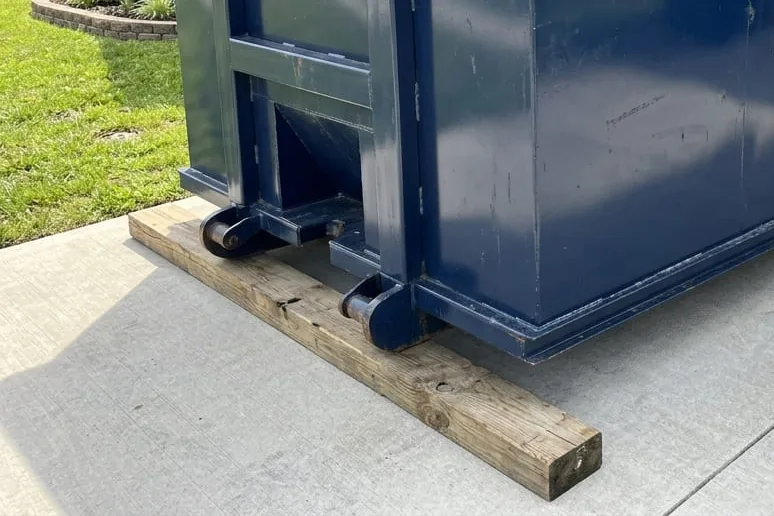
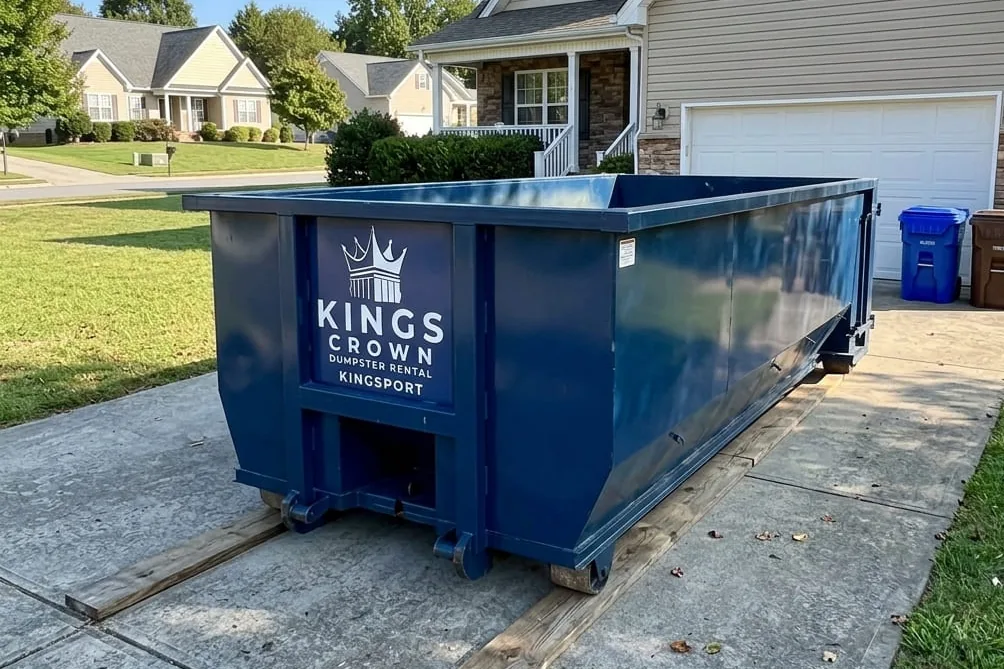
The driveway needs planning too. Roll-offs load on steel rollers and a rear roller bar, and asphalt marks easily in a warm Kingsport summer. Plywood or heavy timbers under the rails and rear rollers spread the load; sealed concrete deserves the same. See our guide to protecting your driveway.
Sequencing a One-Day Versus Multi-Day Tear-Off
On a single-day tear-off, the container needs to be on site the evening before. Everything comes off in one push and the risk is running out of tonnage at three in the afternoon with a third of the roof exposed. Plan that swap in advance rather than discover it — same-day and next-day swaps are easier to arrange when expected.
Multi-day jobs, or a homeowner doing one slope a weekend, work differently. Load evenly front to back rather than heaping over the axle, and keep everything below the top rail — an overloaded box cannot be tarped and won't be hauled. Cover it if a Tri-Cities thunderstorm is due, because saturated shingles and felt gain real weight.
What Else Comes Off With the Shingles
Shingles are the bulk but rarely the whole load. Underlayment felt, old step and valley flashing, drip edge, ridge vent, pipe boots and several thousand nails all come off with them. Felt adds surprising weight when it's the old 30-pound saturated type layered up over decades. Metal flashing is light but awkward and sharp.
Then there's decking. You rarely know a sheet is rotten until the shingles are off, and it changes the calculation — half-inch plywood runs around 40 to 50 pounds a sheet, and older board sheathing is heavier still. Budget for the possibility. Finish with a magnetic sweep of the drive and lawn.
Sorting, Age and Disposal
Asphalt roofing debris is handled as construction and demolition waste and goes to permitted facilities under the state's solid waste program — see tn.gov/environment, or ask Sullivan or Hawkins County solid waste about local practice. Some Tennessee markets recycle shingles into paving material; availability varies.
One genuine caution on older buildings: roofing felts, mastics and some flashing cements manufactured before around 1980 could contain asbestos, and disturbing those materials is regulated. The EPA's asbestos pages explain where it turns up in building materials. If you're working on a pre-1980 structure and suspect it, stop and have it assessed before tear-off — it is not something to put in a roll-off and hope.
Keep a handful of things out of the roofing box regardless: tires, lead-acid batteries and used oil are prohibited from landfill disposal in Tennessee, along with the usual paints, solvents and pressurised cylinders that sometimes migrate out of a garage during a project.
Booking the Right Container
Count your squares, count your layers, check the shingle type, add ten percent, then match the tonnage — not the volume. If the answer is close to a limit, book the smaller box and plan a swap. That's the pattern that keeps roofing jobs on schedule and on budget across Sullivan and Hawkins County, whether it's a planned replacement or a hail or wind-damage tear-off after an East Tennessee storm.
Kings Crown Dumpster Rental works with roofing crews and homeowners across the Tri-Cities. See our roofing dumpster service or get in touch at (423) 830-4153.
Kings Crown Dumpster Rental
Written by the team that runs the trucks out of our yard on 2009 Independence Way in Kingsport. We have been hauling
roll-offs across Sullivan County and upper East Tennessee since 2014. Questions about your own job?
Call (423) 830-4153.
Talk to a real person
Ready to book a container in Kingsport?
Call and describe the job. Flat price, stated tonnage, and a delivery time on the same call.
How many squares of shingles fit in a 20 yard dumpster?
Volume is rarely the limit — weight is. A 20 yard container carries a 3 to 4 ton allowance, which covers roughly 25 to 30 squares of a single layer of lighter three-tab shingles, or closer to 16 to 22 squares of heavier architectural product. Two layers roughly halves those figures. Count your layers before booking, because a full tonnage allowance is reached long before the box looks full.
Why not just order a 30 yard to be safe on a roof tear-off?
Because the extra capacity you gain is volume, not weight. Stepping from a 20 yard to a 30 yard adds around a ton of allowance while nearly doubling the cubic yards, so you pay for space shingles cannot legally fill. The 30 yard's six-foot walls also make throwing debris down harder, and its larger footprint is awkward on the steep, narrow driveways common around Kingsport.
How do I estimate my roof size in squares without getting on the roof?
Measure the building footprint including attached garage or porch, multiply length by width, then add 8 to 12 percent for eave and rake overhangs. Correct for pitch: roughly 5 percent for a 4/12, 12 percent for a 6/12, 20 percent for an 8/12, and up to 40 percent for very steep roofs. Divide the result by 100 to get squares.
Does old felt, flashing and rotten decking count toward the weight?
Yes, and people routinely forget it. Underlayment felt, drip edge, step and valley flashing, ridge vent, pipe boots and nails typically add 5 to 10 percent on top of the shingle weight. Rotten decking adds far more — a sheet of half-inch plywood runs about 40 to 50 pounds, and older board sheathing is heavier. Build that margin into your estimate before choosing a container.
Where should the dumpster sit during a tear-off?
As close to the longest run of eave as the ground safely allows, parallel to the house, so the crew throws shingles down instead of carrying them. Protect gutters below the work area, cover beds and shrubs with plywood rather than tarps, and lay boards under the rails and rear rollers on asphalt or decorative concrete. Tell the driver which slope you are starting on, because a roll-off cannot be repositioned once placed.
The question homeowners ask last and worry about first. Where a roll-off container's weight really concentrates, why delivery and pick-up are the risky minutes, how asphalt, concrete and gravel each fail, and what to tell your hauler before the truck arrives.
Clearing a house does not have to swallow a weekend. Here is a room-by-room cleanout plan built for Kingsport homes, with sizing guidance, the four-pile sorting method, the items that need their own disposal route, and how to stage a steep driveway.
A roll-off does not go to one place. Here is how Tennessee's landfill classes work, which materials have real recycling value or a dedicated route, what must be handled separately, and how to sort a house cleanout so it costs less.